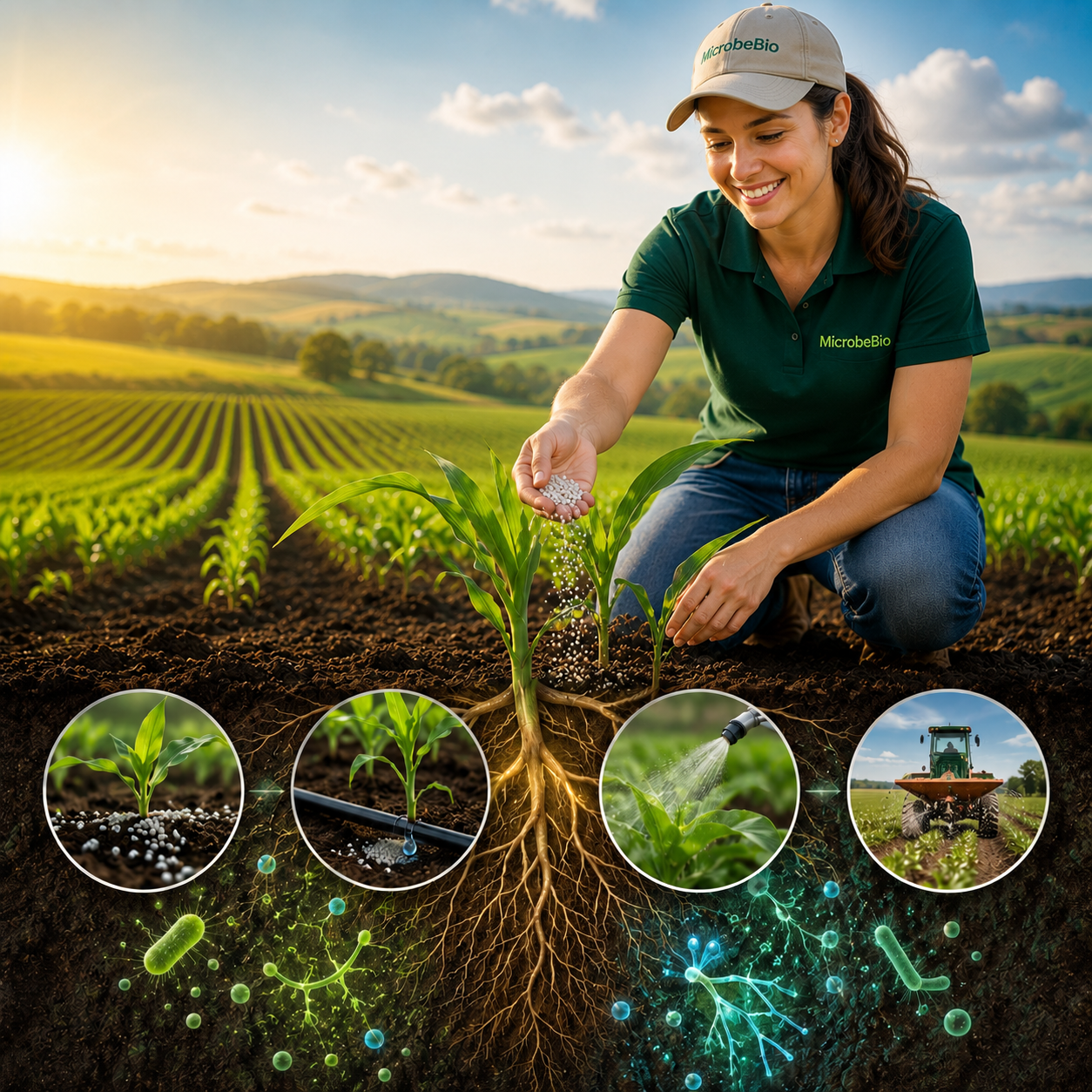
A MicrobeBio® Farmer Q&A Guide to Maximizing Nutrient Efficiency
Proper fertilizer application is just as important as choosing the right fertilizer. Even the highest-quality fertilizer can underperform if it is applied incorrectly. The right application method increases nutrient availability, reduces waste, protects the environment, and helps crops reach their full genetic potential.
At MicrobeBio®, we believe fertilizer should work with biology, not against it. Healthy soils, beneficial microorganisms, and efficient nutrient management are the keys to producing higher yields while using fewer inputs.
Here are the four most effective fertilizer application methods every grower should understand.
Q1. Why is the way fertilizer is applied so important?
Answer:
Plants can only absorb nutrients that reach the active root zone or leaf surface in an available form. Improper placement often leads to nutrient loss through leaching, runoff, volatilization, or fixation in the soil.
Correct application helps:
-
Increase fertilizer efficiency
-
Improve nutrient uptake
-
Reduce fertilizer costs
-
Promote stronger root systems
-
Support healthier soil biology
-
Increase crop yield and quality
-
Reduce environmental impact
When combined with biological soil technologies such as MicrobeBio® Rhizo Activator™, Nature Vigor™, Aqua Activator™, and Hydro Activator™, nutrient availability and fertilizer efficiency can be improved even further by supporting beneficial microbial activity.
Q2. What is Broadcast Application?
Broadcast Application
Broadcasting involves spreading granular fertilizer evenly across the entire field before planting or during crop growth.
This is the most common fertilizer application method worldwide because it is simple, fast, and suitable for large farming operations.
Best for:
-
Rice
-
Wheat
-
Corn
-
Barley
-
Oats
-
Pasture
-
Forage crops
-
Large-scale commercial farming
Advantages
Fast application
Easy for mechanized farming
Good for pre-plant fertilization
Uniform nutrient distribution
Considerations
Broadcast fertilizer should ideally be incorporated into the soil before planting whenever possible. Incorporation reduces nitrogen loss and places nutrients closer to developing roots.
Adding biological soil amendments during broadcast applications can help activate soil microorganisms that gradually convert nutrients into more plant-available forms.
Q3. What is Localized (Band) Application?
Localized or Band Placement
Band application places fertilizer several centimeters away from the seed or plant stem and close to the developing root system.
Instead of feeding the entire field, nutrients are concentrated where the crop can access them most efficiently.
Best for
-
Corn
-
Soybeans
-
Vegetables
-
Fruit trees
-
Cotton
-
Sugarcane
Advantages
Higher nutrient use efficiency
Less fertilizer waste
Better early root development
Reduced phosphorus fixation
Improved crop establishment
Important Tip
Never place fertilizer directly against the stem, trunk, or seed.
High fertilizer concentrations can cause salt injury and root burn, reducing early plant growth.
Maintain a safe distance between fertilizer and the plant while keeping it close enough for rapid root access.
Q4. What is Foliar Application?
Foliar Feeding
Foliar application delivers nutrients directly onto plant leaves, where they are absorbed through the leaf surface and stomata.
This method provides rapid correction of nutrient deficiencies and is particularly valuable during periods of high crop demand.
Best for
-
Micronutrients
-
Calcium
-
Magnesium
-
Zinc
-
Iron
-
Boron
-
Water-soluble specialty fertilizers
-
Biological biostimulants
Best Application Time
Early morning
Late afternoon
Cooler temperatures
Avoid spraying during hot midday conditions to reduce evaporation and leaf burn.
Advantages
Rapid nutrient absorption
Quick correction of deficiencies
Reduced nutrient losses
Improved flowering and fruit development
Increased stress tolerance
MicrobeBio® biological foliar technologies can also help stimulate beneficial microbial activity on the leaf surface while supporting stronger plant metabolism.
Q5. What is Fertigation?
Fertigation
Fertigation combines fertilization and irrigation by injecting water-soluble nutrients into drip or micro-irrigation systems.
This method delivers nutrients directly to the active root zone throughout the growing season.
It is considered one of the most efficient nutrient delivery systems available in modern agriculture.
Best for
-
Orchards
-
Vineyards
-
Vegetables
-
Greenhouses
-
High-value crops
-
Drip irrigation systems
Advantages
Precise nutrient placement
Excellent fertilizer efficiency
Lower fertilizer losses
Better water management
Continuous nutrient supply
Stronger root development
Higher yields
Improved fruit quality
Fertigation also works exceptionally well with biological products that establish beneficial microorganisms around the root system.
Q6. Which fertilizer application method is best?
Answer:
There is no single “best” method. The ideal choice depends on:
-
Crop species
-
Soil type
-
Irrigation system
-
Climate
-
Growth stage
-
Fertilizer type
Many successful growers combine several application methods throughout the season.
For example:
Pre-Plant
Broadcast or band fertilizer with biological soil conditioners.
↓
Vegetative Growth
Foliar nutrition and biological stimulants.
↓
Flowering & Fruit Development
Fertigation combined with biological nutrient enhancers.
This integrated approach provides continuous nutrition while maximizing nutrient efficiency.
Q7. How can biological soil technology improve fertilizer performance?
Answer:
Healthy soil biology plays a major role in nutrient cycling.
Beneficial microorganisms help:
-
Unlock phosphorus tied up in soil
-
Improve nitrogen cycling
-
Increase root surface area
-
Produce natural plant growth compounds
-
Improve soil structure
-
Increase organic matter decomposition
-
Enhance water retention
-
Improve nutrient uptake efficiency
When fertilizer and biology work together, growers often achieve stronger plant growth while improving long-term soil health.
Q8. What are the biggest fertilizer application mistakes?
Avoid these common errors:
Applying too much fertilizer
Placing fertilizer directly against stems or roots
Applying before heavy rainfall
Spraying foliar nutrients during extreme heat
Ignoring soil testing
Applying nutrients at the wrong crop growth stage
Neglecting soil biological activity
Small improvements in application practices can significantly increase fertilizer efficiency and crop performance.
MicrobeBio® Best Practices for Better Crop Growth
At MicrobeBio®, we encourage growers to think beyond fertilizer alone. Sustainable crop production begins with healthy soil, active microbial communities, balanced nutrition, and efficient application methods.
By combining the right fertilizer placement strategy with biological technologies, farmers can:
Improve nutrient use efficiency
Develop stronger root systems
Increase microbial activity
Enhance soil organic matter
Improve water-use efficiency
Reduce fertilizer losses
Support healthier crops
Produce higher-quality yields
Final Thoughts
The future of agriculture is not about using more fertilizer—it is about using fertilizer more intelligently.
Whether you broadcast nutrients across a field, place them precisely near the roots, spray them directly onto leaves, or deliver them through irrigation systems, proper timing and placement make all the difference.
When these proven fertilizer application methods are paired with biological soil technologies, growers can maximize productivity while protecting the long-term health of their soil.
Healthy Soil. Smarter Nutrition. Better Harvests.
MicrobeBio® — Biology Rising™

Trending Hashtags
#MicrobeBio #BiologyRising #SustainableAgriculture #RegenerativeAgriculture #SoilHealth #CropNutrition #PlantScience #Fertilizer #BiologicalAgriculture #SmartFarming #Agriculture #HealthySoil #RootDevelopment #PrecisionAgriculture #FarmInnovation #AgTech #Farmers #OrganicFarming #FoodSecurity #GrowMoreWithLess