Microbebio and the Future of High-Performance Parsley Production
Parsley is more than just a garnish. It is a high-value culinary and medicinal crop prized for its rich aroma, vibrant green color, essential oils, antioxidants, chlorophyll, vitamins, and nutritional density. Modern parsley production requires more than simple fertilization. Growers today must balance high yield, strong plant health, shelf life, environmental sustainability, soil regeneration, and consumer demand for cleaner food.
The Microbebio system was designed to support every stage of parsley growth through advanced biological agriculture. By combining beneficial microbes, mycorrhizae, organic nutrients, natural biostimulants, and soil-regenerating technologies, Microbebio helps growers build stronger plants from the root zone upward while protecting the environment and improving long-term farm profitability.
Unlike traditional fertilizer systems that often focus only on short-term nutrient delivery, Microbebio works to restore the living biology of the soil while improving plant metabolism, nutrient efficiency, stress tolerance, and crop quality.
Why Parsley Requires a Biological Approach
Parsley is highly sensitive to:
- Soil compaction
- Poor oxygen levels
- Salinity buildup
- Root diseases
- Nutrient lockout
- Heat stress
- Excess moisture
- Weak microbial activity
- Chemical residue accumulation
Traditional synthetic fertilizer programs may temporarily stimulate growth, but over time they can reduce microbial diversity, lower soil organic matter, increase salt accumulation, and weaken soil structure. This creates a cycle of dependency where growers must apply more chemical inputs each season to maintain production.
Microbebio helps break that cycle.
By restoring beneficial biological activity in the rhizosphere, Microbebio transforms the soil into a living ecosystem capable of supporting stronger parsley crops naturally and sustainably.
How Microbebio Benefits Every Stage of Parsley Growth
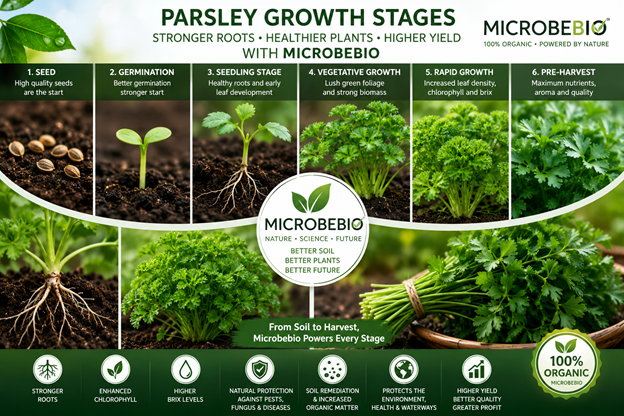
- Seed Germination and Early Root Development
Healthy parsley production begins below the soil surface.
Microbebio beneficial microbes colonize the seed and root zone early, helping:
- Improve germination uniformity
- Stimulate root emergence
- Increase root hair development
- Improve oxygen exchange
- Unlock bound nutrients
- Reduce transplant shock
- Protect young roots from pathogens
A stronger root system allows parsley plants to absorb more water and nutrients efficiently throughout the crop cycle.
This early biological activation often leads to:
- Faster establishment
- Better stand uniformity
- Increased biomass accumulation
- Reduced seedling mortality
- Enhanced Chlorophyll and Photosynthesis
Microbebio technologies help parsley maximize chlorophyll production and photosynthetic efficiency.
Higher chlorophyll levels allow plants to convert more sunlight into usable energy, supporting:
- Faster vegetative growth
- Darker green coloration
- Increased leaf density
- Stronger stems
- Higher carbohydrate production
- Improved nutrient transport
Microbial metabolites and organic biostimulants also help improve stomatal function and plant respiration, increasing the efficiency of photosynthesis under stressful environmental conditions.
The result is vigorous parsley growth with healthier foliage and stronger market appearance.
Higher Brix Levels Mean Better Quality
Brix levels measure dissolved sugars, minerals, and nutrient density inside plant sap.
Higher Brix parsley often demonstrates:
- Better flavor
- Stronger aroma
- Higher nutritional quality
- Increased essential oil production
- Improved shelf life
- Greater resistance to pests and disease
Microbebio enhances Brix levels by improving:
- Nutrient uptake efficiency
- Photosynthesis
- Root activity
- Mineral availability
- Symbiotic microbial interactions
Plants with higher Brix levels are naturally more resilient because healthier plants are less attractive to many insect pests and opportunistic pathogens.
Natural Protection Against Pests, Fungus, and Disease
Parsley crops are vulnerable to many production threats, including:
- Root rot
- Damping off
- Powdery mildew
- Leaf spot
- Aphids
- Thrips
- Whiteflies
- Soil-borne fungal pathogens
Microbebio supports natural crop defense through biological competition and microbial dominance in the rhizosphere.
Beneficial microbes help:
- Occupy infection sites before pathogens can establish
- Produce natural antimicrobial compounds
- Enhance plant immune responses
- Improve root health
- Reduce stress-related disease outbreaks
- Increase environmental resilience
This biological approach helps reduce dependence on harsh chemical pesticides while promoting a healthier agricultural ecosystem.
Soil Remediation and Organic Matter Improvement
Healthy soil is the foundation of sustainable parsley production.
Years of chemical-heavy farming often result in:
- Reduced microbial diversity
- Soil compaction
- Poor water infiltration
- Salinity buildup
- Low organic matter
- Nutrient lockup
- Erosion vulnerability
Microbebio works to rebuild soil biology naturally.
The Microbebio system helps:
- Increase beneficial microbial populations
- Improve soil aggregation
- Enhance organic matter decomposition
- Improve nutrient cycling
- Increase water retention
- Improve aeration and oxygen availability
- Reduce nutrient leaching
- Stimulate earthworm and biological activity
As soil health improves, parsley plants become more efficient and productive with lower long-term input requirements.
Waterway and Environmental Protection
Traditional fertilizers often contribute to:
- Nitrogen runoff
- Phosphorus pollution
- Algal blooms
- Water contamination
- Soil degradation
- Greenhouse gas emissions
Microbebio promotes a regenerative approach that protects surrounding ecosystems.
By improving nutrient efficiency and biological nutrient cycling, Microbebio helps reduce:
- Fertilizer runoff
- Excess nitrate accumulation
- Chemical residue pollution
- Soil erosion
- Environmental stress
Improved soil organic matter also acts like a sponge, helping soils retain water more effectively and reducing irrigation demand.
This supports cleaner waterways and healthier ecosystems for future generations.
Better for Human and Animal Health
Consumers worldwide are increasingly demanding cleaner, healthier, and more sustainable food production systems.
Microbebio supports:
- Reduced chemical residue
- Cleaner production methods
- Healthier soil ecosystems
- Improved nutrient density
- Safer farming environments
- Reduced environmental contamination
Healthier soils produce healthier plants, which ultimately support healthier food systems for humans and animals alike.
Increased Shelf Life and Marketability
One of the major challenges in parsley production is maintaining freshness after harvest.
Microbebio helps improve post-harvest quality by supporting:
- Stronger cell walls
- Better calcium utilization
- Improved water balance
- Higher antioxidant activity
- Enhanced plant metabolism
- Reduced oxidative stress
This can help parsley maintain:
- Freshness
- Color retention
- Aroma
- Texture
- Nutritional value
Longer shelf life reduces waste throughout the supply chain and increases profitability for growers, distributors, and retailers.
Higher Yield and Greater Profitability
Microbebio is designed to improve overall production efficiency.
Benefits commonly associated with biologically active production systems include:
- Increased biomass
- Stronger root systems
- Better nutrient efficiency
- Improved stress tolerance
- Reduced crop losses
- Higher market quality
- Reduced input dependency
- Better water efficiency
These improvements can translate into:
- Higher yields
- Premium crop quality
- Lower production costs
- Reduced chemical dependency
- Greater long-term profitability
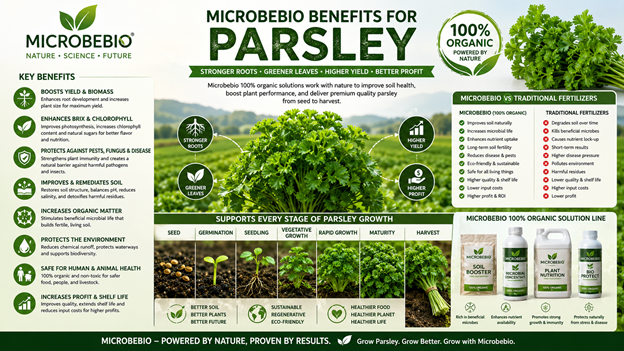
Why Choose Microbebio Over Traditional Fertilizers?
Traditional Fertilizer Systems
Traditional programs often focus mainly on feeding the plant directly through synthetic salts.
Long-term challenges may include:
- Soil degradation
- Salt buildup
- Reduced microbial life
- Nutrient lockout
- Increased disease pressure
- Water pollution
- Lower soil organic matter
- Reduced long-term sustainability
The Microbebio Difference
Microbebio focuses on feeding both the plant and the soil biology.
The Microbebio system supports:
- Living soil ecosystems
- Beneficial microbial diversity
- Long-term soil fertility
- Regenerative agriculture
- Sustainable production
- Nutrient efficiency
- Environmental protection
- Biological resilience
Rather than forcing temporary growth, Microbebio helps create a naturally productive agricultural system capable of sustaining high-performance parsley production season after season.
The Future of Sustainable Parsley Farming
Modern agriculture must evolve beyond simple chemical dependency.
The future belongs to biological systems that:
- Restore soil life
- Protect ecosystems
- Improve food quality
- Increase profitability
- Reduce environmental damage
- Support long-term sustainability
Microbebio represents this next generation of agriculture — combining science, biology, sustainability, and performance into one integrated system.
From seed germination to harvest and post-harvest quality, Microbebio helps parsley growers achieve stronger yields, healthier soils, cleaner production, improved shelf life, and greater profitability while protecting human health, animal health, and the environment.