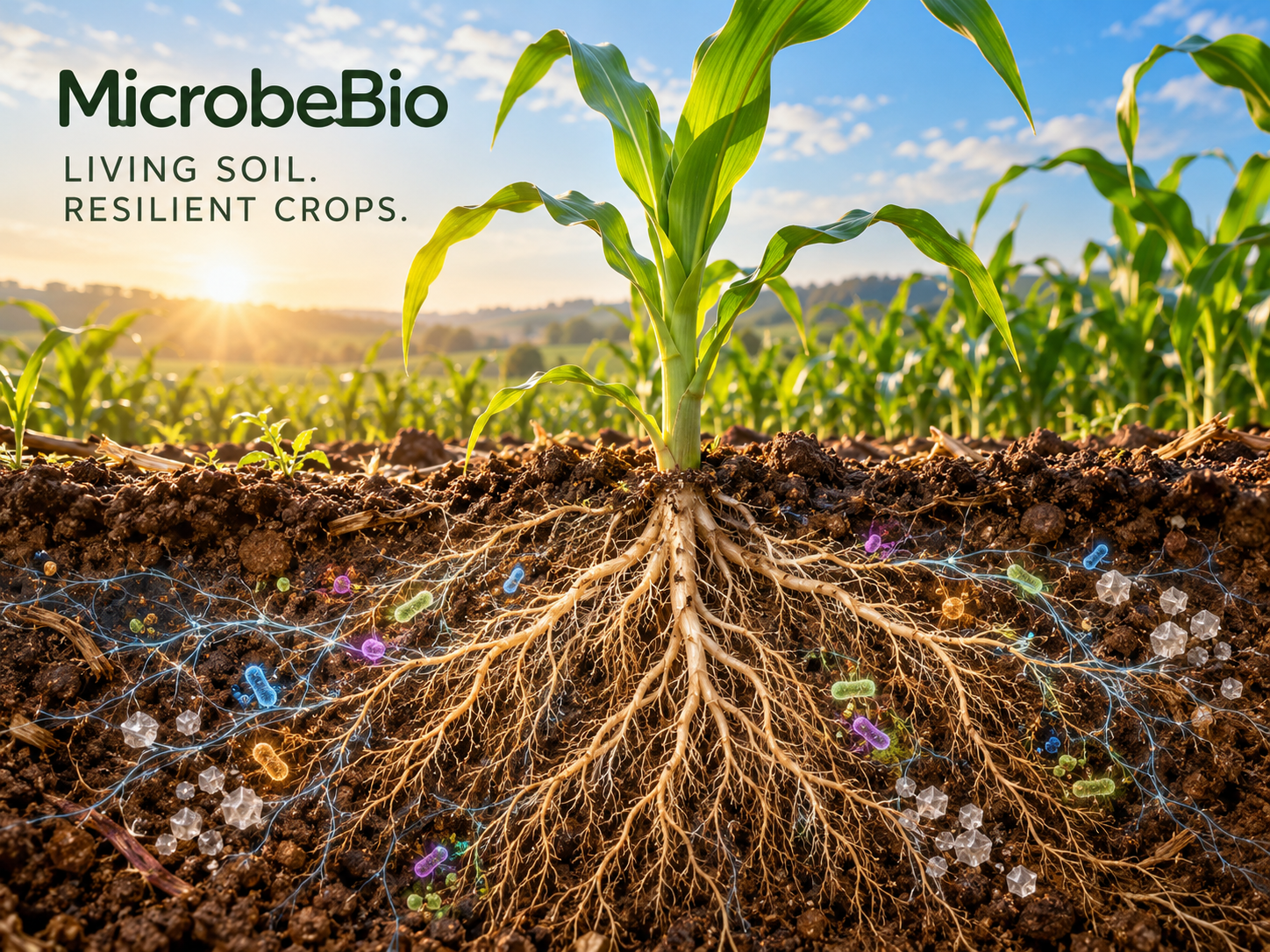
MicrobeBio: Living Soil, Resilient Crops, and the Biology of Better Harvests
How microbial partnerships, balanced nutrition, and biological protection can help crops manage salt stress and reach their yield potential
A productive harvest begins beneath the surface.
Around every root is a dynamic environment where water, minerals, organic matter, and microorganisms interact. When that environment functions well, crops have a stronger foundation for establishment, nutrient uptake, growth, and production. When salinity, disease, or poor soil conditions disrupt it, even carefully managed fields can struggle.
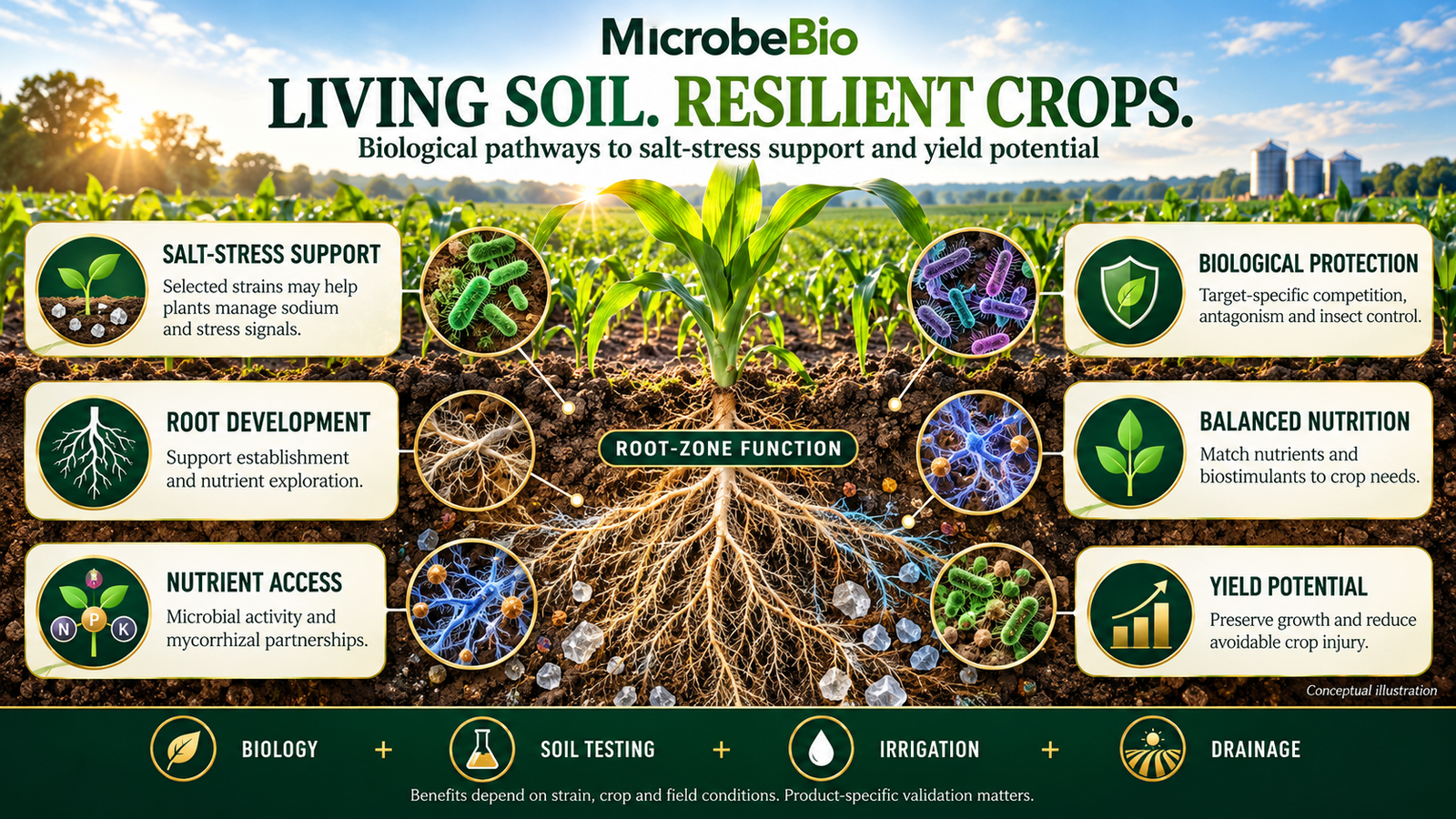
MicrobeBio’s agricultural portfolio brings together complementary approaches to this challenge: beneficial bacteria, fungi, mycorrhizal partnerships, biological crop protection, organic-based nutrition, and environmental biotechnology.
The opportunity is to support the processes that make agriculture productive—helping roots function, nutrients circulate, crops withstand stress, and harvest potential survive the season.
Salt-stress mitigation is an important part of that vision. Selected microorganisms can help plants cope with saline conditions, while sound soil and water management addresses the salts themselves.
Salt Stress: A Challenge to Water, Nutrition, and Yield
Salt stress often begins before symptoms become obvious.
As dissolved salts accumulate in the root zone, plants must expend more energy to absorb water. Sodium and chloride can interfere with normal cellular processes, while nutrient imbalances limit growth. A field may contain moisture yet leave crops experiencing physiological water stress.
The consequences can include uneven establishment, restricted roots, reduced canopy development, and lost productivity.
Salinity also affects soil biology. Microorganisms differ in their sensitivity to salts, and the processes they perform—including growth, decomposition, and nitrogen transformations—can respond differently to salt exposure. Maintaining biological function therefore requires more than simply increasing microbial numbers.
For growers, the goal is practical: preserve a functioning root zone and productive crop while preventing further salt accumulation.
Helping Plants Manage Sodium and Maintain Essential Nutrients
One promising microbial mechanism involves plant ion balance.
Plants need potassium and calcium for essential physiological functions. Excess sodium can disrupt that balance. Certain beneficial bacterial strains have been shown to influence sodium transport or reduce sodium accumulation in plants under experimental salt stress.
Research involving selected Bacillus strains has demonstrated effects on sodium transport, plant growth, and tissue ion composition. These findings provide a scientific basis for investigating microbial approaches to salinity resilience. They remain specific to the strains, crops, and conditions studied.
For MicrobeBio, this creates a clear development objective: identify organisms that remain functional in saline root zones and evaluate whether they help crops maintain healthier nutrient relationships.
Better plant ion balance can support crop tolerance. It does not, by itself, mean the soil has been desalinated.
Moderating Stress Signals That Restrict Root Growth
Plants use chemical signals to respond to their environment. Under stress, these signals can help activate defenses, but they can also restrict growth.
Some beneficial bacteria produce ACC deaminase, an enzyme that breaks down a precursor of ethylene. In suitable plant–microbe interactions, this mechanism can moderate excessive stress-associated ethylene and help preserve root development.
A salt-tolerant bacterial isolate studied in wheat combined ACC deaminase activity with root colonization and other beneficial traits. Its application improved growth measurements under sodium chloride stress.
This mechanism matters because roots are the crop’s connection to water and nutrition. Supporting root growth during stress may help preserve establishment and later productivity, provided that the benefit persists through the growing season.
Supporting the Root Microenvironment
Certain microorganisms produce extracellular polysaccharides—natural polymers that surround microbial cells and contribute to their local environment.
These materials can support attachment and biofilm formation. Some can bind ions, potentially modifying sodium exposure around roots. Research with selected bacteria has investigated these traits alongside improvements in plant performance under salinity.
This is a localized biological process. Its field importance depends on microbial activity, soil conditions, and successful establishment.
MicrobeBio’s approach can use these mechanisms as selection criteria: prioritize organisms that deliver useful functions where roots actually grow, then measure their contribution under realistic conditions.
Building a More Effective Nutrient Partnership
Crop nutrition involves both nutrient supply and access.
MicrobeBio’s biological portfolio includes organisms selected for roles associated with nutrient mobilization, organic-matter transformation, and root-zone activity. These functions offer pathways for improving how crops interact with existing soil resources.
Potential mechanisms include:
-
Mobilizing certain forms of phosphorus and other minerals.
-
Contributing to the breakdown of organic residues.
-
Supporting biological nitrogen processes where the organisms and conditions permit.
-
Influencing root development and nutrient exploration.
Each function requires the right organism, an appropriate environment, and sufficient resources. Microbial activity does not create an unlimited nutrient supply, and nutrient-mobilizing organisms cannot compensate for a soil that lacks the needed elements.
The practical aim is better nutrient access within a balanced fertility program. Any reduction in fertilizer requirements should follow measured crop response and nutrient accounting.
Extending Root Reach Through Mycorrhizal Partnerships
Beneficial mycorrhizal fungi form associations with compatible plant roots. Their hyphae explore soil beyond the immediate root surface, creating an additional pathway for nutrient acquisition.
Phosphorus uptake is a particularly important area of research. Experiments with mycorrhizal maize have demonstrated benefits to phosphorus acquisition and water-use efficiency during recovery from drought. Separate salt-stress experiments show that the surrounding bacterial community can influence colonization and plant response.
For compatible crops, these partnerships provide another avenue for supporting root-zone function.
Successful use depends on host compatibility, inoculum viability, placement, soil conditions, and nutrient management. The presence of fungal propagules alone does not establish successful root colonization.
Combining Biological Support With Humic Materials, Seaweed, and Nutrition
MicrobeBio’s portfolio also includes approaches that combine biological support with humic materials, seaweed-derived components, and mineral nutrition.
These components address different aspects of crop performance. Nutrients supply essential elements. Humic materials and seaweed extracts can be evaluated for their effects on roots, nutrient relations, and stress responses.
Greenhouse research with a particular seaweed extract demonstrated growth and productivity benefits in tomatoes exposed to salinity. Such findings support further investigation, but seaweed source, extraction method, concentration, and application conditions affect the result.
Balanced nutrition is essential. Adding more fertilizer to an already adequately supplied crop does not automatically improve salt tolerance. Excess nutrient applications can increase the root-zone salt burden.
The strongest program supplies what the crop needs while accounting for the combined salt contribution of irrigation water, fertilizers, and amendments.
Protecting Roots Through Biological Competition and Antagonism
Crop growth and crop protection are closely connected.
A root damaged by disease has less capacity to absorb water and nutrients. When disease occurs alongside salinity, the combined stress can further restrict crop performance.
MicrobeBio’s biological protection approach draws on several mechanisms found among selected beneficial bacteria and fungi:
Competition for resources and colonization sites. Beneficial organisms may occupy root-associated niches and compete with certain pathogens for nutrients.
Antimicrobial activity. Some strains produce compounds that inhibit susceptible pathogens.
Fungal antagonism and mycoparasitism. Certain beneficial fungi interact directly with pathogenic fungi, including through enzymes that affect fungal structures.
Plant defense stimulation. Some interactions influence plant signaling and prepare the host to respond to subsequent challenges.
Research with selected Bacillus and Trichoderma treatments supports the possibility of growth and protection benefits under saline conditions, including experiments involving wheat pathogens. These effects cannot be generalized to every strain or disease.
For growers, biological protection should be matched to the diagnosed problem and integrated with other appropriate practices.
Preserving Harvest Potential Through Biological Insect Management
Insects reduce productivity by feeding on foliage, stems, roots, flowers, and developing fruit. Preventing that injury helps preserve the crop’s investment in growth.
MicrobeBio’s insect-focused biological approaches include microorganisms with different modes of action.
Entomopathogenic fungi offer candidates for managing susceptible insects through infection. Certain bacterial agents act through insecticidal proteins, with activity determined by the organism’s strain, protein profile, and the pest’s susceptibility.
For example, the insect targets of Bacillus thuringiensis depend on whether its proteins interact with receptors in the insect larval gut. A bacterial count alone does not establish insecticidal potency or a broad pest spectrum.
The yield benefit is primarily protective: less feeding damage can leave more productive leaf area and healthier crop structures.
Target-specific testing remains essential. Evidence against an insect does not establish effectiveness against nematodes or snails; those uses need their own validation.
Environmental Biotechnology and Responsible Water Reuse
Agricultural resilience also depends on what enters the field.
Microbial environmental biotechnology can be evaluated for improving organic-waste treatment and supporting the management of water intended for reuse. That role connects environmental stewardship with agricultural resource efficiency.
However, organic-load treatment and salt removal are different processes. Treated water may still contain concentrations of dissolved salts unsuitable for unrestricted irrigation. Water quality must be assessed for the intended crop and soil.
Responsible reuse considers salinity, sodium-related infiltration risk, nutrients, and other relevant water-quality parameters. A healthier crop begins with suitable inputs as well as a functioning root zone.
How These Mechanisms Can Support Yield
Yield results from successful growth across the entire season.
Microbial and nutritional approaches may contribute at several points:
|
Stage
|
Desired contribution
|
|---|---|
|
Establishment
|
More consistent emergence, transplant recovery, and early root growth
|
|
Vegetative growth
|
Better access to water and nutrients, with less stress-related restriction
|
|
Crop protection
|
Reduced losses from susceptible pests and pathogens
|
|
Reproductive development
|
Maintenance of the plant resources needed for flowering and crop formation
|
|
Harvest
|
Preservation of marketable yield and quality
|
These are outcomes to measure, rather than automatic consequences of applying a biological input.
A larger seedling does not necessarily produce a larger harvest. Likewise, improved tissue nutrient status does not establish fertilizer savings. MicrobeBio’s strongest yield story is built through replicated trials that connect mechanisms with crop performance and economic return.
Working With Biology While Managing the Salts
A complete salinity program addresses the source of stress.
Saline soils contain excessive soluble salts. Sodic soils contain excessive exchangeable sodium, which can impair soil structure and infiltration. Some fields have both problems.
Appropriate management may involve better irrigation water, improved drainage, planned leaching, crop selection, and calcium amendments where sodicity warrants them. Amendment requirements must follow diagnosis.
Biology can be evaluated as a supporting layer within this program—helping crops cope and maintaining useful root-zone functions while physical and chemical management controls salt accumulation.
Microbial support, nutrition, irrigation, and drainage work best when they are planned together.
Validation Is Part of the Value
The performance of biological inputs depends on strain identity, viability, formulation, placement, crop, soil, and management.
Combinations deserve particular attention. Adding more organisms or fertilizer does not guarantee a stronger result. A tomato experiment found that a particular beneficial-fungus and fertilization combination interfered with adaptive responses to salt stress.
A meaningful MicrobeBio evaluation should compare standard management with the same management plus the biological treatment. It should measure roots, establishment, salinity, tissue ion balance, disease or pest injury where relevant, marketable yield, and net return.
The mechanisms described here are supported by research involving selected organisms and materials. Their presence in the scientific literature does not establish the efficacy of every MicrobeBio formulation.
A Living Foundation for Productive Agriculture
MicrobeBio’s portfolio brings together a broad agricultural vision: support the root zone, improve nutrient relationships, protect crops from avoidable injury, and explore biological pathways for resilience under stress.
The promise of microbiome-based agriculture lies in useful functions—organisms that remain active, interact effectively with crops, and deliver measurable value.
For salt-affected agriculture, that promise deserves careful development. Better root growth, healthier ion balance, effective protection, and suitable nutrition may help crops preserve more of their yield potential when supported by sound soil and water management.
MicrobeBio — advancing biological approaches for healthier soils, more resilient crops, and productive harvests.
Ready to explore a biology-based approach to crop resilience? Start with your crop, soil analysis, irrigation-water quality, and production goals—and build a program around the conditions in your field.