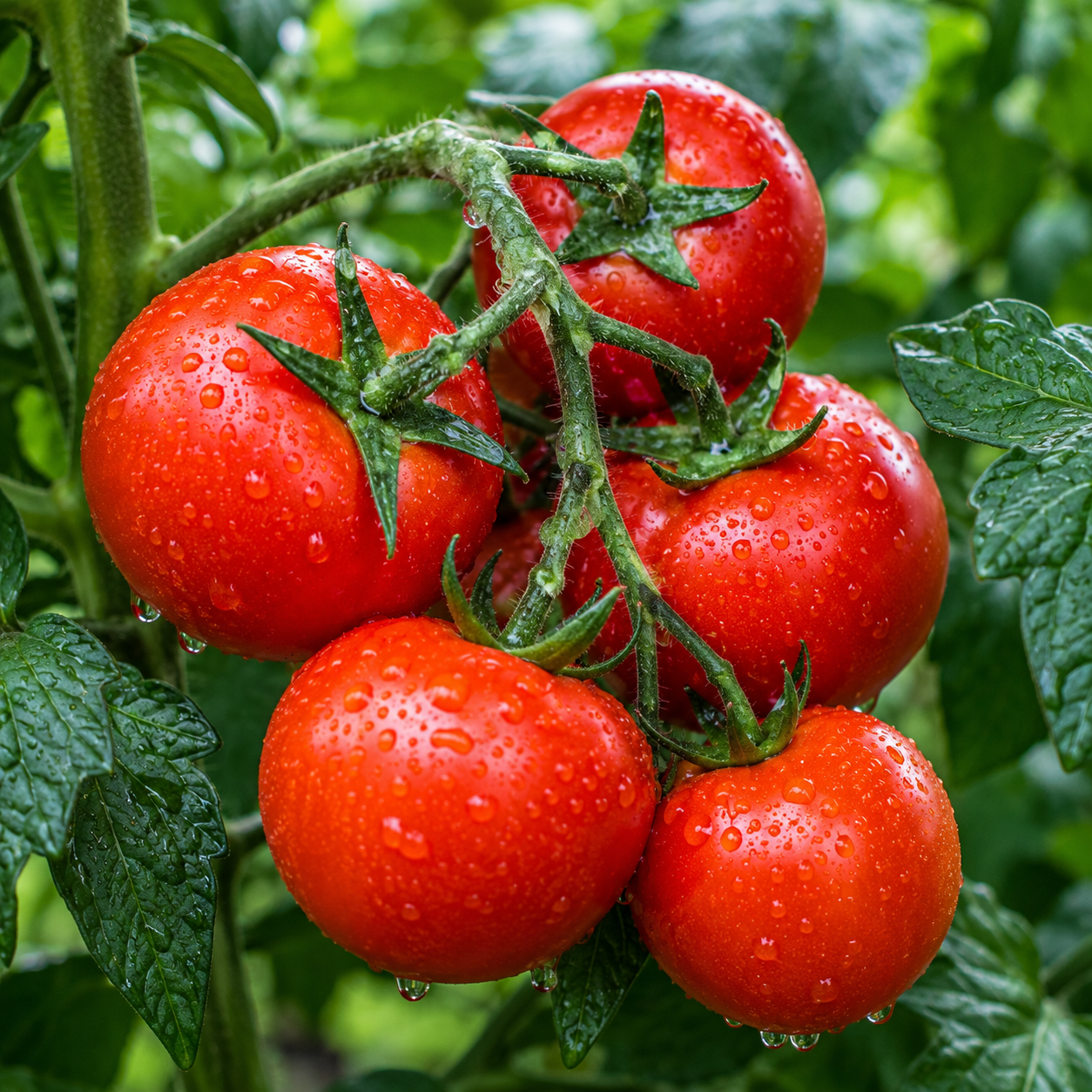
Tomato Nutrient Deficiencies: How to Identify, Correct, and Prevent Them with Biological Crop Nutrition
Tomato plants are highly productive crops, but that productivity comes with significant nutritional demands. From seedling establishment and vegetative growth to flowering, fruit set, fruit filling, and harvest, tomatoes require a balanced and continuously available supply of essential nutrients.
When nutrition becomes unbalanced, tomato plants often show visible warning signs. Lower leaves may turn yellow. New leaves may become pale while their veins remain green. Leaf margins may look scorched. Plants may become stunted or develop purple foliage. Fruit can ripen unevenly, crack, or develop blossom-end rot.
Recognizing these symptoms early can help growers respond before nutrient stress significantly affects plant health, fruit quality, or yield.
But successful nutrient management requires more than simply adding fertilizer.
A nutrient may already be present in the soil but unavailable to the crop because of poor root development, unfavorable pH, salinity, inconsistent irrigation, low biological activity, nutrient antagonism, or other soil conditions.
At MicrobeBio®, the goal is to approach plant nutrition as an integrated biological system: support the soil, strengthen the root zone, improve nutrient availability, and deliver targeted nutrition when and where the crop needs it.
Why Tomato Nutrition Starts Below the Soil
Healthy tomato production begins with the root system.
Roots must continuously acquire water and essential nutrients while interacting with the surrounding soil environment. When roots are weak, damaged, waterlogged, drought-stressed, or affected by soilborne problems, nutrient uptake can decline even when fertilizer is present.
This is why MicrobeBio’s approach combines biological soil and root technologies with targeted nutritional products rather than treating every visible deficiency as simply a lack of fertilizer.
Products such as Rhizo Activator™, Aqua Activator™, Nature Vigor™, and Hydro Activator™ can form the biological and nutritional foundation of the program, while MicrobeBio Precision Nano Nutrients™ provide targeted mineral nutrition based on crop needs.
The objective is a healthier soil-root-plant continuum capable of supporting tomatoes throughout their entire production cycle.
1. Nitrogen Deficiency in Tomato Plants
What does nitrogen deficiency look like?
Nitrogen is essential for chlorophyll, proteins, enzymes, amino acids, and vegetative development.
Because nitrogen is mobile within the plant, deficiency symptoms usually begin on older leaves as the plant redistributes available nitrogen toward younger tissues.
Common signs include:
- Pale green foliage
- Yellowing of older or lower leaves
- Reduced leaf size
- Thin stems
- Slow vegetative growth
- Reduced canopy development
- Premature loss of lower leaves
- Poor overall plant vigor
Severe or prolonged nitrogen stress can ultimately reduce the photosynthetic capacity needed to support fruit production.
The MicrobeBio approach
Before simply applying more nitrogen, growers should determine why nitrogen is unavailable.
MicrobeBio’s biological fertility strategy can incorporate Rhizo Activator™ to support the root-zone environment, Nature Vigor™ to support soil organic matter and humic conditions, and Hydro Activator™ as part of the crop’s nutritional program.
Where targeted foliar nutrition is appropriate, MicrobeBio Precision Nano Nutrients™ can complement the broader fertility program.
The goal is not excessive vegetative growth. It is balanced nitrogen availability that supports a productive canopy without sacrificing flowering and fruit production.
2. Phosphorus Deficiency in Tomatoes
Phosphorus plays a central role in plant energy transfer, root development, cellular metabolism, flowering, and reproductive growth.
Signs of phosphorus deficiency
Tomato plants experiencing phosphorus stress may show:
- Dark green foliage
- Blue-green coloration
- Purple or reddish coloration
- Purple coloration beneath leaves
- Slow plant development
- Stunted growth
- Reduced root development
- Delayed reproductive growth
Phosphorus symptoms can be particularly noticeable during early crop establishment.
However, visible phosphorus deficiency does not necessarily mean that the soil contains insufficient phosphorus.
Cold soil, unfavorable pH, poor roots, excessive soil moisture, and other environmental conditions can reduce phosphorus uptake.
The MicrobeBio approach
Aqua Activator™ and Rhizo Activator™ can be incorporated into a biological root-zone strategy designed to support microbial activity, root development, and nutrient availability.
Nature Vigor™ can complement this strategy by supporting soil organic matter and the rhizosphere environment.
When tissue or soil testing identifies a specific nutritional need, targeted Precision Nano Nutrients™ can be incorporated into the program.
A strong phosphorus strategy should therefore address both sides of the equation:
Is enough phosphorus present, and can the roots actually access it?
3. Potassium Deficiency and Tomato Fruit Quality
Potassium becomes especially important as tomato plants enter flowering, fruit set, and fruit filling.
It contributes to water regulation, stomatal function, enzyme activation, carbohydrate transport, stress response, fruit development, and quality.
Signs of potassium deficiency
Watch for:
- Yellowing along older leaf margins
- Brown leaf margins
- Scorched-looking leaf edges
- Marginal necrosis
- Reduced plant vigor
- Poor fruit development
- Uneven ripening
- Reduced fruit quality
As fruit load increases, potassium demand can become substantial.
The MicrobeBio approach
A potassium management program should not focus exclusively on the amount of potassium applied. Root health, moisture, nutrient interactions, and overall plant balance also matter.
MicrobeBio’s integrated strategy can combine the biological root-zone foundation with Hydro Activator™, Foliar™, and targeted Precision Nano Nutrients™ during periods of elevated crop demand.
During reproductive growth, Upshot™ can also be incorporated into the MicrobeBio program to support fruit development, quality, and the plant’s reproductive phase.
The goal is to help the plant efficiently support its developing fruit load rather than simply increasing fertilizer concentration.
4. Magnesium Deficiency in Tomato Plants
Magnesium is particularly important because it is the central element in the chlorophyll molecule.
Without adequate magnesium availability, photosynthetic performance can decline.
What magnesium deficiency looks like
The classic symptom is interveinal chlorosis on older leaves.
Growers may observe:
- Yellowing between leaf veins
- Veins remaining green
- Symptoms beginning on lower or older foliage
- Progressive yellowing
- Brown or necrotic areas in severe cases
- Premature leaf decline
Magnesium deficiency can sometimes be confused with other nutrient problems, making the location of symptoms important.
The MicrobeBio approach
MicrobeBio’s Precision Nano Mg™ provides a targeted magnesium option that can be incorporated when crop monitoring or analysis indicates magnesium demand.
But magnesium should not be considered independently.
Excessive levels of other cations, including potassium and calcium, can affect magnesium uptake. Soil pH, moisture, root condition, and salinity can also influence availability.
For this reason, Precision Nano Mg™ is best positioned within an integrated nutrition strategy supported by biological root-zone management rather than as a substitute for diagnosing the underlying cause.
5. Calcium Deficiency and Blossom-End Rot
Few tomato disorders are as recognizable as blossom-end rot.
Affected fruit typically develops a discolored or water-soaked area at the blossom end. As the disorder progresses, the area becomes brown to black, flattened, sunken, and leathery.
Why does blossom-end rot happen?
Calcium is essential for cell-wall development, membrane stability, growing tissues, root development, and fruit integrity.
However, blossom-end rot does not necessarily mean there is no calcium in the soil.
Calcium movement within plants is closely associated with water movement. Consequently, several conditions can interfere with calcium delivery to developing fruit:
- Irregular irrigation
- Drought stress
- Rapid fluctuations in soil moisture
- Root damage
- Excessive salinity
- Poor root development
- Rapid plant and fruit growth
- Nutritional imbalance
Adding calcium without correcting the root-zone or irrigation problem may therefore fail to solve the underlying issue.
The MicrobeBio approach
Where calcium supplementation is appropriate, MicrobeBio Precision Nano Ca™ can be incorporated into a targeted nutritional program.
At the same time, MicrobeBio’s broader biological approach emphasizes root health and consistent nutrient acquisition through products such as Rhizo Activator™, Aqua Activator™, and Nature Vigor™.
The strategy is straightforward:
Supply calcium when needed, but also create the conditions that allow the plant to use it.
6. Iron Deficiency in Tomato Plants
Iron is required in relatively small quantities, but it plays critical roles in plant metabolism and processes associated with chlorophyll formation.
How to recognize iron deficiency
Iron deficiency typically affects young leaves first.
Symptoms include:
- Yellowing of new leaves
- Green veins remaining visible
- Pronounced interveinal chlorosis
- Very pale young foliage in severe cases
- Reduced new growth
This distinction can help separate iron deficiency from magnesium deficiency.
Magnesium deficiency generally begins on older leaves. Iron deficiency generally appears on younger leaves.
The MicrobeBio approach
Where iron deficiency has been properly identified, Precision Nano Fe™ can provide targeted iron nutrition within the overall crop program.
However, growers should also investigate soil pH and root-zone conditions.
Iron can be present in soil yet remain poorly available to plants under certain chemical conditions. Correcting the environment that limits iron availability can therefore be just as important as applying iron itself.
7. Boron Deficiency and Tomato Reproductive Growth
Boron is a micronutrient, meaning plants require much smaller amounts than nitrogen, phosphorus, or potassium. Its importance, however, should not be underestimated.
Boron contributes to cell-wall formation, growing tissues, flowering, pollen function, and reproductive development.
Potential symptoms can include:
- Distorted young growth
- Brittle tissues
- Poor flowering
- Reduced fruit set
- Abnormal fruit development
- Damage to growing points
The MicrobeBio approach
Precision Nano B™ can be incorporated when analysis and crop conditions indicate a boron requirement, particularly around critical reproductive stages.
Boron requires especially careful management because the difference between insufficient and excessive concentrations can be relatively narrow.
More is not necessarily better.
Targeted application based on crop need is preferable to indiscriminate supplementation.
8. Zinc, Manganese, Copper, and Other Micronutrient Deficiencies
Tomatoes require numerous micronutrients in relatively small amounts, including:
Zinc (Zn), manganese (Mn), copper (Cu), boron (B), iron (Fe), and molybdenum (Mo).
Although required in small quantities, these elements participate in critical metabolic, enzymatic, photosynthetic, and reproductive processes.
Deficiencies can contribute to:
- Chlorosis
- Leaf discoloration
- Reduced internode growth
- Small leaves
- Distorted growth
- Reduced flowering
- Poor fruit development
- Lower plant vigor
Precision Nano Nutrition™
The MicrobeBio Precision Nano Nutrients™ portfolio provides targeted options including:
Precision Nano Ca™, Mg™, Fe™, Zn™, B™, Cu™, Mn™, Mo™ and Complete™.
Rather than assuming every tomato crop requires the same micronutrient package, growers can use soil analysis, tissue analysis, crop stage, and field observations to determine which nutritional interventions are appropriate.
This supports a more precise approach to crop nutrition.
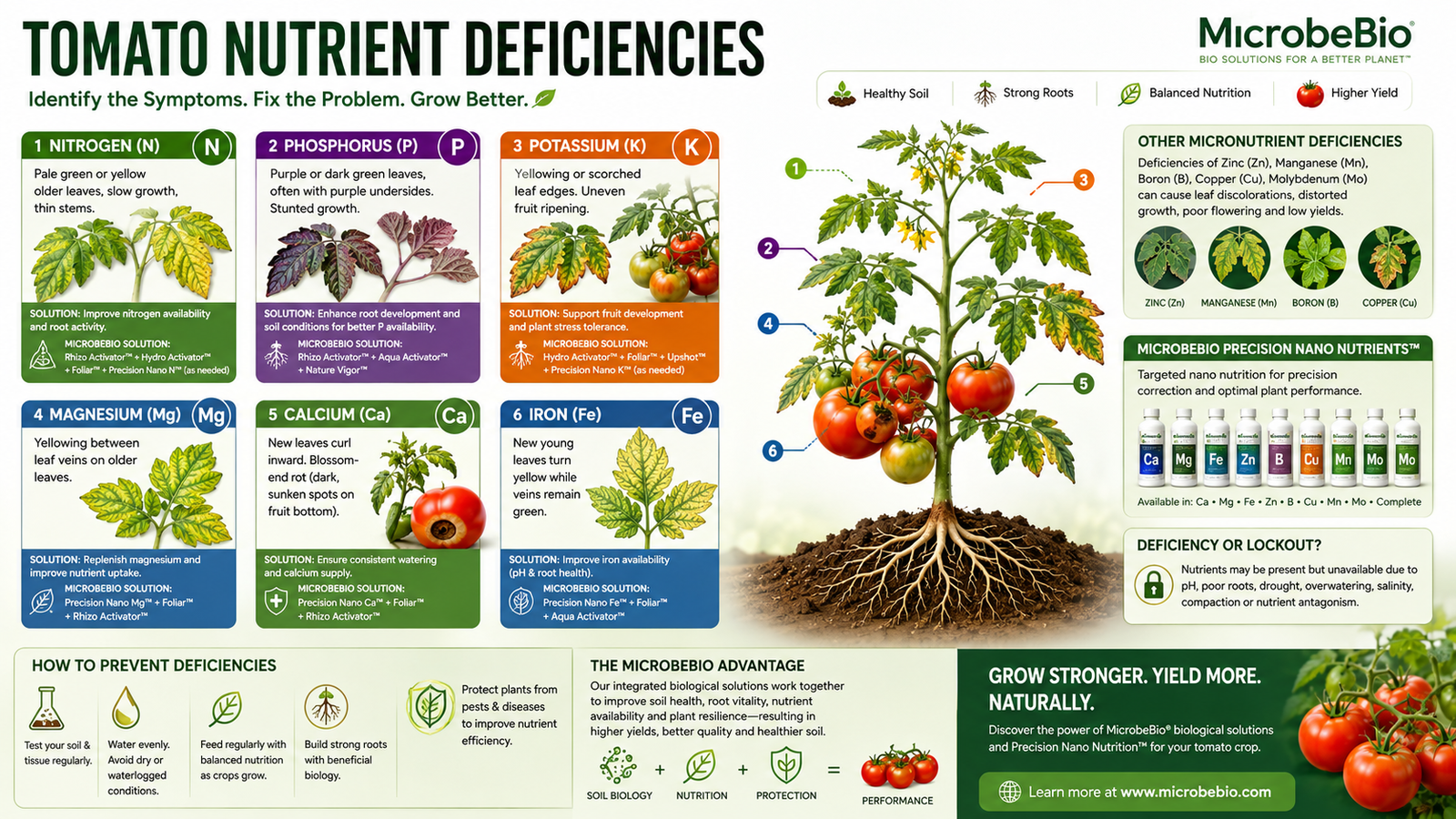
Deficiency or Nutrient Lockout? Know the Difference
One of the most important concepts in tomato nutrition is that a plant can show deficiency symptoms even when the nutrient is present in the soil.
The problem may be availability rather than quantity.
Several conditions can interfere with nutrient acquisition.
Soil pH
Soil pH affects nutrient chemistry and availability. A nutrient can become increasingly difficult for roots to acquire when pH conditions are unfavorable.
Poor Root Health
Roots affected by pathogens, nematodes, compaction, salinity, oxygen deprivation, or physical damage cannot efficiently acquire nutrients.
MicrobeBio’s X1™ can be integrated into root and soil management programs where nematode and root-zone pressures are relevant.
Root and Soil Diseases
Root diseases can produce above-ground symptoms that resemble nutritional deficiencies.
X5™ can be incorporated into an integrated biological disease-management program where susceptible soilborne or foliar disease pressures are present.
Excessive or Insufficient Water
Too little water reduces nutrient transport through the soil.
Too much water reduces soil oxygen and can damage roots.
Consistent irrigation is therefore part of nutrient management.
Nutrient Antagonism
Nutrients interact.
Excessive application of one element can reduce uptake of another. This is one reason MicrobeBio encourages balanced and precision-based nutrition rather than indiscriminate fertilizer application.
Biological Crop Protection Also Protects Nutrient Efficiency
Plant nutrition cannot be separated completely from pest and disease management.
A tomato plant losing photosynthetic leaf area to disease or insects will not use nutrition as efficiently as a healthy plant.
MicrobeBio’s biological crop-management approach can integrate:
X1™ for root-zone and nematode management, X3™ for biological insect management, and X5™ for biological disease management.
Where appropriate, botanical technologies such as Nature Venom™ and Green Fury™ can complement an integrated crop-protection strategy.
The objective is to protect the biological machinery that converts water, sunlight, carbon dioxide, and nutrients into marketable tomatoes.
Match Tomato Nutrition to the Growth Stage
Tomatoes do not have identical nutritional requirements throughout their lifecycle.
Establishment and Root Development
The first objective is establishing a large, functional root system and biologically active rhizosphere.
A MicrobeBio program may incorporate:
Rhizo Activator™ + Aqua Activator™ + Nature Vigor™ + X1™
to establish the biological and root-zone foundation.
Vegetative Development
As canopy growth accelerates, plants need balanced nutrition capable of supporting leaves, stems, roots, and photosynthetic capacity.
The program can incorporate:
Hydro Activator™ + Foliar™ + targeted Precision Nano Nutrients™
based on crop requirements.
Flowering and Fruit Set
Nutritional priorities begin shifting toward reproductive development.
Particular attention should be given to micronutrient balance, calcium, potassium, boron, irrigation consistency, and plant stress.
Fruit Filling and Ripening
Heavy fruit loads increase nutritional and water demand.
A program may incorporate:
Hydro Activator™ + Foliar™ + Upshot™ + targeted Precision Nano Ca™, Mg™, B™, K-related nutrition and other Precision Nano Nutrients™ as required.
Applications should always be adjusted according to soil conditions, tissue analysis, variety, climate, production system, crop stage, and local agronomic recommendations.
The MicrobeBio Tomato Nutrition System
Rather than treating nutrition, roots, soil biology, pests, and disease as unrelated problems, MicrobeBio brings these areas together within an integrated biological crop-management strategy.
| Crop Need | MicrobeBio Approach |
|---|---|
| Soil biological foundation | Nature Vigor™ |
| Root-zone development | Rhizo Activator™ |
| Biological activation | Aqua Activator™ |
| Plant nutrition | Hydro Activator™ |
| Foliar nutrition | Foliar™ |
| Precision micronutrients | Precision Nano Nutrients™ |
| Root/nematode management | X1™ |
| Biological insect management | X3™ |
| Biological disease management | X5™ |
| Reproductive/fruit stage | Upshot™ |
| Botanical crop protection | Nature Venom™ / Green Fury™ |
The exact combination should be selected according to crop needs rather than applying every product automatically.
How to Diagnose Tomato Nutrient Deficiencies Before Treating Them
Before making major corrections, ask four questions.
1. Where did the symptoms appear first?
Old leaves often point toward mobile nutrients such as nitrogen, potassium, phosphorus, or magnesium. New growth can suggest problems involving less-mobile nutrients such as iron or calcium.
2. What does the symptom look like?
Uniform yellowing, interveinal chlorosis, purple coloration, scorched margins, distorted growth, and fruit disorders provide different diagnostic clues.
3. What is happening below ground?
Inspect soil moisture, drainage, compaction, salinity, root density, root color, nematode pressure, and disease symptoms.
4. What do the tests show?
For commercial production, combine visual diagnosis with soil and plant tissue analysis whenever possible.
A leaf may tell you where to look.
Testing helps tell you what to do next.
Better Tomato Nutrition Starts with a Better Biological System
The future of tomato nutrition is not simply about applying more fertilizer.
It is about improving the efficiency of the entire soil-root-plant system.
When soil biology is active, roots are healthy, irrigation is consistent, and nutrients are delivered according to plant demand, tomatoes are better positioned to express their productive potential.
That is the philosophy behind MicrobeBio.
Soil Biology + Root Health + Precision Nutrition + Biological Protection
By integrating Rhizo Activator™, Aqua Activator™, Nature Vigor™, Hydro Activator™, Foliar™, Upshot™, X1™, X3™, X5™, and MicrobeBio Precision Nano Nutrients™, growers can build a more complete biological strategy from establishment through harvest.
The goal is not simply to correct a yellow leaf.
It is to build healthier soil, stronger roots, more efficient nutrient utilization, resilient plants, high-quality fruit, and a more productive crop.
Grow Better Tomatoes with MicrobeBio®
Seeing yellow leaves, purple foliage, blossom-end rot, poor fruit set, or uneven ripening in your tomato crop?
Don’t guess. Diagnose. Then build the right biological and nutritional program.
MicrobeBio® combines biological soil technologies, root-zone solutions, plant nutrition, Precision Nano Nutrition™, and biological crop protection into integrated programs designed around the needs of the crop.
Whether you’re managing a commercial field, protected production system, greenhouse, or intensive tomato operation, MicrobeBio can help develop a program around your soil conditions, crop stage, nutritional requirements, and production goals.
Build the soil. Strengthen the roots. Feed with precision. Protect biologically.