Tomato Nutrient Deficiencies: How to Identify, Correct, and Prevent Them
Healthy tomato plants depend on a carefully balanced supply of nutrients throughout their life cycle. From establishing a strong root system and building a productive canopy to flowering, fruit development, ripening, and harvest, each stage places different nutritional demands on the plant.
When one or more essential nutrients become unavailable, tomato plants often communicate the problem through visible changes in their leaves, stems, flowers, roots, or fruit. Yellowing leaves, purple coloration, scorched leaf margins, distorted new growth, poor flowering, uneven fruit development, and blossom-end rot can all be signs that plant nutrition is out of balance.
However, seeing a symptom does not necessarily mean the soil contains too little of a particular nutrient. Nutrient availability is influenced by soil pH, moisture, temperature, root health, salinity, microbial activity, nutrient interactions, and other environmental conditions. A nutrient can be present in the soil but remain unavailable to the plant.
Understanding both the visual symptoms and the underlying causes is therefore essential for effective tomato nutrient management.
Why Balanced Nutrition Matters for Tomato Production
Tomatoes are relatively nutrient-demanding plants, particularly when grown for high yields. During early development, the crop must establish roots and vegetative growth. As plants begin flowering and setting fruit, nutrient demand changes substantially.
Nitrogen supports vegetative growth and chlorophyll production. Phosphorus contributes to energy transfer, root development, flowering, and reproductive processes. Potassium plays a major role in water regulation, plant metabolism, fruit development, and quality. Calcium contributes to cell-wall structure and fruit integrity, while magnesium is a central component of chlorophyll. Iron and numerous other micronutrients support essential enzymatic and metabolic processes.
The goal is not simply to supply more fertilizer. Successful nutrition depends on providing the right nutrients, in the right proportions, at the right growth stage, under conditions that allow the roots to absorb them.
1. Nitrogen Deficiency
What Nitrogen Does
Nitrogen is fundamental to plant growth. It is required for amino acids, proteins, enzymes, nucleic acids, and chlorophyll.
Tomato plants require adequate nitrogen to develop the photosynthetic canopy needed to support flowering and fruit production.
What Nitrogen Deficiency Looks Like
One of the clearest characteristics of nitrogen deficiency is that symptoms usually begin on older leaves.
Common symptoms include:
-
Older leaves becoming pale green
-
Progressive yellowing of lower leaves
-
Reduced vegetative growth
-
Smaller leaves
-
Thin or weak stems
-
Reduced canopy development
-
Premature loss of older leaves
-
Lower overall plant vigor
Because nitrogen is mobile within the plant, a tomato plant can relocate nitrogen from older tissues to actively growing young tissues. This is why lower leaves frequently show symptoms first.
What Can Cause It?
Nitrogen deficiency can result from low soil nitrogen, insufficient fertilizer, nutrient leaching, poor root development, low organic matter, or conditions that interfere with nutrient uptake.
Excessive irrigation or heavy rainfall can be particularly important because nitrate is highly mobile in soil and can move below the active root zone.
Management
Soil and tissue testing can help determine whether additional nitrogen is actually needed. Nitrogen applications should also be balanced against crop stage and anticipated yield.
Excess nitrogen is not necessarily beneficial. Overapplication can encourage excessive vegetative growth at the expense of reproductive development and may create additional nutritional imbalances.
2. Phosphorus Deficiency
What Phosphorus Does
Phosphorus is involved in energy transfer, root development, cell division, flowering, and reproductive development.
It is particularly important during early establishment and reproductive growth.
What Phosphorus Deficiency Looks Like
Phosphorus-deficient tomato plants may display:
-
Slow or stunted growth
-
Dark green foliage
-
Blue-green coloration
-
Purple or reddish coloration on leaves
-
Purple coloration on the undersides of leaves
-
Delayed plant development
-
Poor root development
The characteristic purple coloration is associated with the accumulation of pigments called anthocyanins.
A Deficiency May Not Mean the Soil Lacks Phosphorus
Cold soil is a common example. Tomato roots absorb phosphorus less efficiently under cool conditions, meaning a plant may temporarily display phosphorus-deficiency symptoms even when phosphorus is present.
Soil pH can also strongly influence phosphorus availability.
Management
Before applying large amounts of phosphorus, evaluate soil phosphorus levels, soil temperature, pH, moisture, and root condition.
Correcting the conditions preventing uptake can sometimes be more effective than simply applying additional fertilizer.
3. Potassium Deficiency
What Potassium Does
Potassium is particularly important as tomato plants move into flowering and fruit production.
It contributes to:
-
Water regulation
-
Stomatal function
-
Enzyme activation
-
Carbohydrate transport
-
Plant stress response
-
Fruit development
-
Fruit quality and uniformity
Tomatoes can have substantial potassium demand during fruit filling.
What Potassium Deficiency Looks Like
Symptoms often appear first on older leaves and may include:
-
Yellowing along leaf margins
-
Browning or scorching of leaf edges
-
Marginal leaf necrosis
-
Weak or stressed-looking foliage
-
Reduced plant vigor
-
Poor fruit development
-
Uneven ripening
In severe cases, leaf margins may appear burned while tissue closer to the veins remains greener.
Management
Potassium management should consider both soil reserves and crop demand. High levels of competing cations can also affect nutrient balance, so simply increasing potassium without understanding the overall nutrient profile may create additional problems.
For commercial production, soil and tissue analysis provide a more reliable basis for potassium management than visual symptoms alone.
4. Magnesium Deficiency
What Magnesium Does
Magnesium sits at the center of the chlorophyll molecule and therefore plays a direct role in photosynthesis.
It is also involved in enzyme activity, energy metabolism, and nutrient transport.
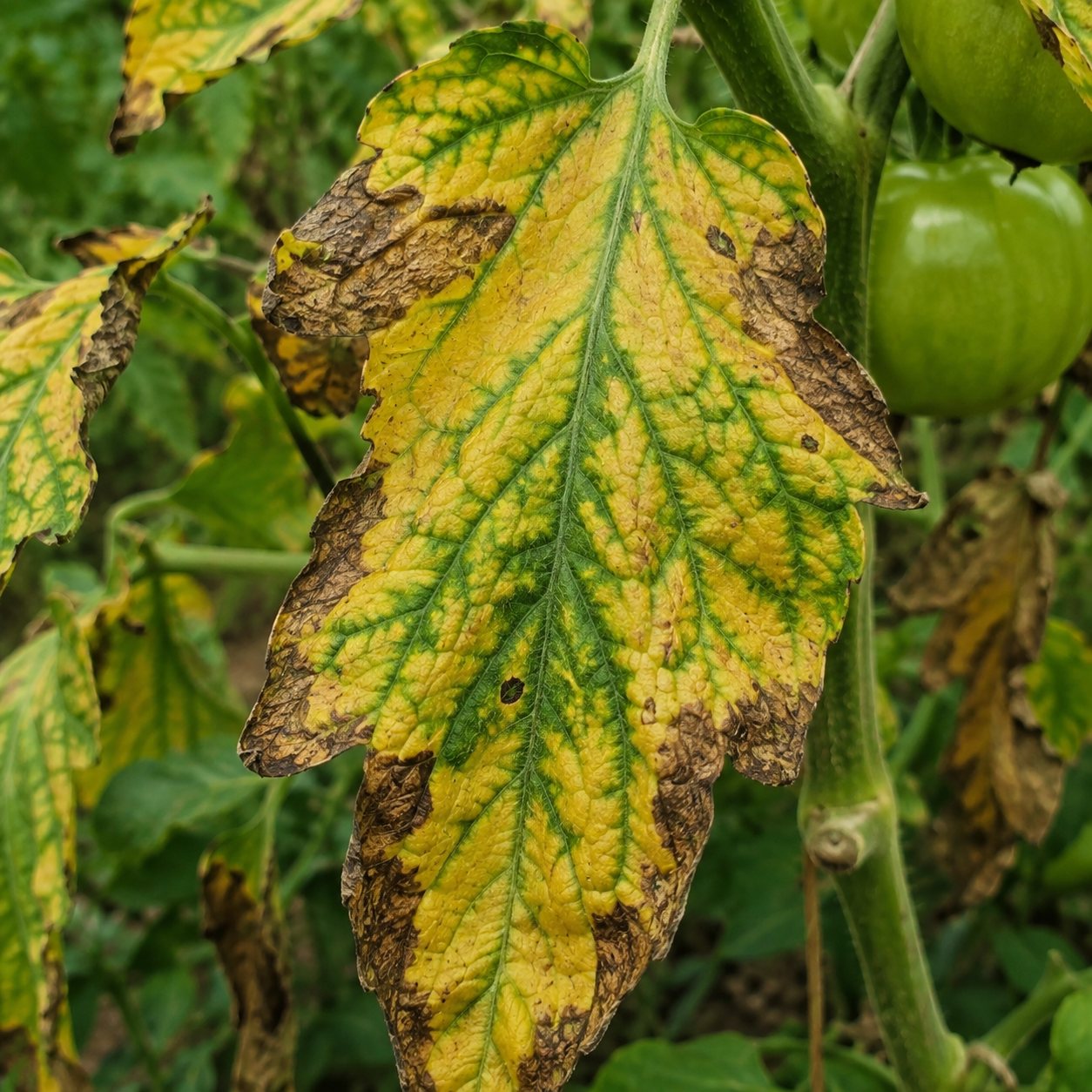
What Magnesium Deficiency Looks Like
Magnesium deficiency commonly begins on older leaves.
The classic symptom is interveinal chlorosis.
This means:
-
Tissue between the veins turns yellow
-
Veins remain noticeably green
-
Symptoms begin primarily on older foliage
-
Yellow areas may eventually become brown or necrotic
-
Severe deficiency can cause premature leaf loss
The green-vein/yellow-tissue pattern can make magnesium deficiency relatively recognizable.
Nutrient Competition Matters
Magnesium problems are not always caused by a simple lack of magnesium.
High concentrations of potassium, calcium, or other nutrients can interfere with magnesium uptake. Root-zone conditions and pH may also influence availability.
This illustrates an important principle of plant nutrition: nutrients must be managed as a system rather than individually.
5. Calcium Deficiency and Blossom-End Rot
Calcium-related disorders are among the most recognizable nutritional problems in tomatoes.
What Calcium Does
Calcium is essential for:
-
Cell-wall development
-
Cell membrane stability
-
Growing-point development
-
Root growth
-
Fruit tissue strength
Unlike highly mobile nutrients such as nitrogen, calcium is relatively immobile within the plant and depends heavily on water movement through the plant.
What Calcium Deficiency Looks Like
Symptoms can appear in actively growing tissues and may include:
-
Distorted young leaves
-
Curled new growth
-
Damage to growing points
-
Poor root development
-
Fruit disorders
The most famous calcium-associated tomato disorder is blossom-end rot.
What Is Blossom-End Rot?
Blossom-end rot typically appears as a water-soaked or discolored area on the blossom end of developing fruit. The affected area later becomes dark, flattened, leathery, and sunken.
Importantly, blossom-end rot does not automatically mean the soil is deficient in calcium.
The soil may contain adequate calcium while the developing fruit receives too little.
Why?
Because calcium transport is closely connected to water movement.
Irregular irrigation, drought stress, root damage, excessive salinity, rapid growth, or other environmental conditions can disrupt calcium delivery to developing fruit.
Management
Maintaining consistent root-zone moisture is one of the most important preventive strategies.
Avoid allowing plants to alternate repeatedly between severe drought stress and heavy irrigation.
Soil testing should be used before assuming that additional calcium fertilizer is required.
6. Iron Deficiency
What Iron Does
Iron is required for important enzymatic reactions and is closely associated with chlorophyll formation and photosynthetic function.
Although plants require iron in relatively small quantities, inadequate iron availability can produce dramatic symptoms.
What Iron Deficiency Looks Like
Iron deficiency usually appears first on young leaves.
Typical symptoms include:
-
Yellowing of new growth
-
Green veins remaining visible
-
Strong interveinal chlorosis
-
Pale or almost white young leaves in severe cases
-
Reduced growth
This pattern helps distinguish iron deficiency from magnesium deficiency.
Iron deficiency generally affects younger leaves first. Magnesium deficiency generally affects older leaves first.
Soil pH and Iron Availability
Iron may exist in the soil but become chemically unavailable to plants, particularly under unfavorable pH conditions.
Therefore, adding more iron may not permanently solve the problem unless the root-zone conditions causing poor availability are also addressed.
Old Leaves vs. New Leaves: One of the Best Diagnostic Clues
When diagnosing tomato nutrient deficiencies, one of the first questions to ask is:
Where did the symptoms appear first?
This provides an important clue because nutrients differ in their mobility within plants.
Mobile nutrients can be moved from older tissues to younger tissues when supply becomes limited. Their deficiencies therefore tend to become visible on older leaves first.
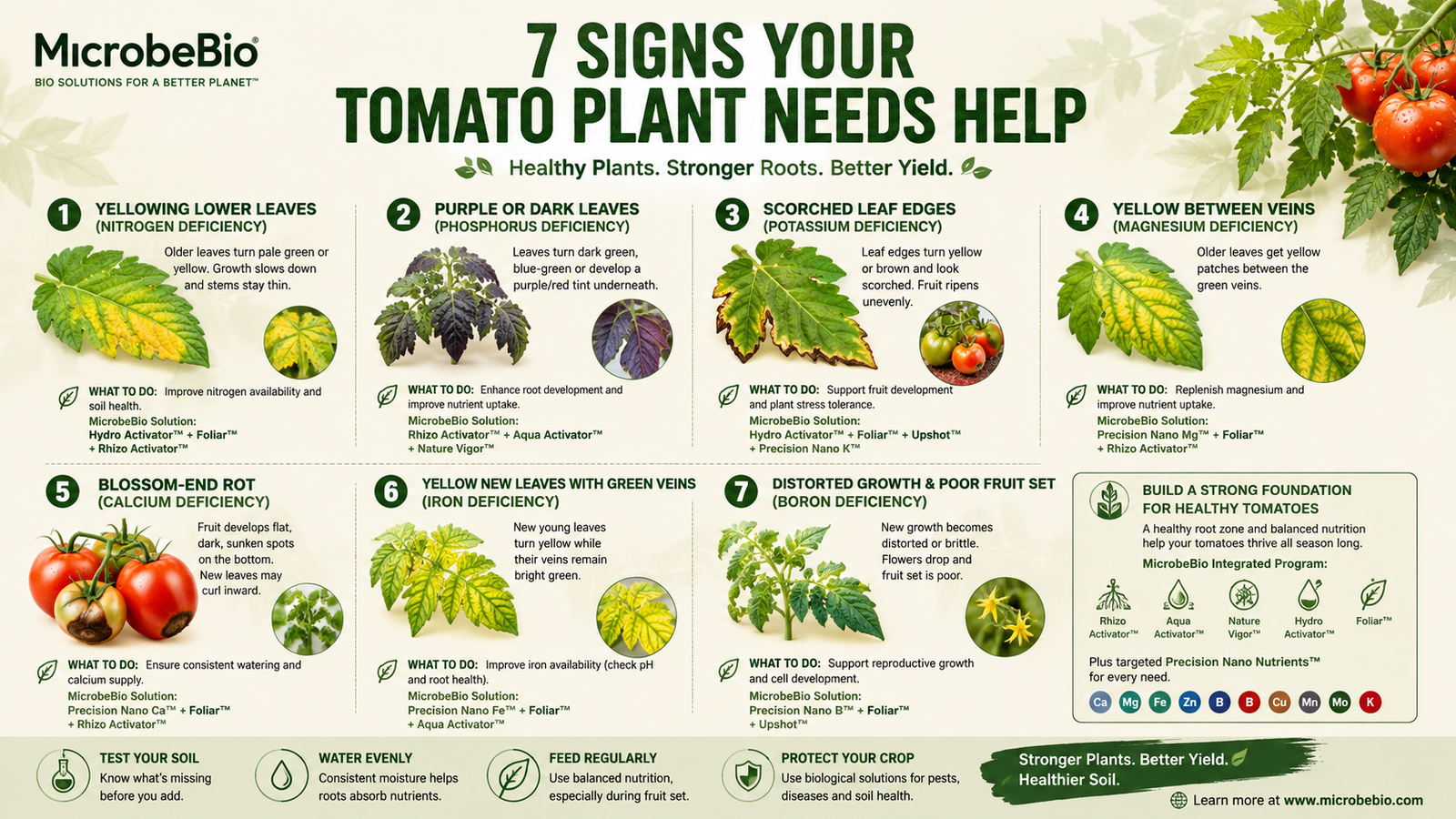
Nitrogen, phosphorus, potassium, and magnesium deficiencies commonly appear first on older foliage.
Less-mobile nutrients are not redistributed as readily. Problems involving nutrients such as calcium or iron therefore tend to become more apparent in new growth, growing points, or developing fruit.
This is not a perfect diagnostic rule, but it provides a useful starting point.
Nutrient Deficiency or Nutrient Lockout?
One of the biggest mistakes in tomato nutrition management is assuming every deficiency symptom means more fertilizer is needed.
Sometimes the nutrient is already present.
The problem is that the plant cannot access it.
This is often referred to as nutrient lockout or reduced nutrient availability.
Several factors can contribute.
Soil pH
Soil pH strongly influences nutrient solubility and availability. When pH moves outside an appropriate range, certain nutrients can become increasingly unavailable even if soil tests show they are present.
Water Stress
Roots require both water and oxygen to function effectively.
Too little water reduces nutrient movement toward roots. Too much water can reduce soil oxygen, impair root activity, and encourage root diseases.
Root Damage
A plant with a compromised root system may display multiple apparent nutrient deficiencies because it cannot efficiently absorb water and minerals.
Potential causes include:
-
Root pathogens
-
Nematodes
-
Compaction
-
Poor drainage
-
Excessive salinity
-
Waterlogging
-
Physical root injury
Temperature
Cold soils can dramatically slow root activity and nutrient uptake. Phosphorus availability and uptake are particularly sensitive to cool conditions.
Nutrient Antagonism
Nutrients interact with one another.
Excessive levels of one element can interfere with the uptake of another. This is why repeatedly applying individual nutrients without testing can sometimes make nutritional problems worse rather than better.
How to Diagnose Tomato Nutrient Problems Correctly
Visual diagnosis is useful, but it should be considered the beginning of the investigation rather than the final answer.
A systematic approach is more reliable.
Step 1: Identify Where Symptoms Started
Determine whether symptoms began on:
-
Old leaves
-
New leaves
-
Growing points
-
Roots
-
Flowers
-
Developing fruit
This helps narrow the potential causes.
Step 2: Examine the Pattern
Look carefully at the discoloration.
Ask whether the plant shows:
-
Uniform yellowing
-
Yellowing between veins
-
Green veins with yellow tissue
-
Purple coloration
-
Brown leaf margins
-
Scorched edges
-
Spots or lesions
-
Leaf curling
-
Distorted growth
-
Dead growing points
Different patterns can point toward different nutritional or physiological problems.
Step 3: Check the Root Zone
Do not diagnose the leaves without considering what is happening underground.
Inspect:
-
Soil moisture
-
Drainage
-
Compaction
-
Root color
-
Root density
-
Root lesions
-
Root decay
-
Salinity
-
Irrigation uniformity
Healthy nutrient uptake begins with a functioning root system.
Step 4: Test the Soil
A soil analysis can provide information on nutrient availability, pH, electrical conductivity, organic matter, and other important properties.
This is particularly valuable before making substantial fertilizer applications.
Step 5: Consider Plant Tissue Analysis
In commercial tomato production, tissue testing can provide another layer of information by showing what nutrients the plant is actually absorbing.
Soil analysis and tissue analysis answer different questions.
Soil testing asks: What is available in the root zone?
Tissue testing asks: What is getting into the plant?
Used together, they can provide a much clearer picture.
Water Management Is Nutrient Management
Irrigation and nutrition cannot be managed independently.
Water moves dissolved nutrients through the soil toward roots and helps transport minerals through the plant.
When soil becomes excessively dry, nutrient movement and uptake decline.
When soil remains saturated, oxygen availability can decrease and root function may suffer.
When irrigation fluctuates dramatically, calcium transport to developing tomato fruit may become inconsistent, increasing the risk of blossom-end rot.
For this reason, consistent moisture management can sometimes correct what initially appears to be a fertilizer problem.
Feed According to the Tomato Growth Stage
Tomato nutrition requirements change throughout the crop cycle.
Establishment and Early Vegetative Growth
The priority is developing:
-
Healthy roots
-
Strong stems
-
Adequate leaf area
-
Balanced vegetative growth
Young plants should receive sufficient nutrition without being pushed into excessive soft vegetative growth.
Pre-Flowering and Flowering
As plants transition toward reproduction, nutrient balance becomes increasingly important.
The crop must support continued canopy development while preparing for flowering, pollination, and fruit set.
Fruit Set
Once fruit begins developing, demand for water and minerals increases substantially.
Potassium and calcium management become particularly important, while overall nutrition must remain balanced.
Fruit Filling and Ripening
The plant must support multiple nutrient sinks simultaneously: developing fruit, new flowers, leaves, stems, and roots.
Good root health, consistent irrigation, and adequate potassium become increasingly important for supporting fruit development and quality.
A Quick Tomato Nutrient Deficiency Guide
|
Nutrient
|
Where Symptoms Often Appear
|
Typical Visual Signs
|
Additional Clues
|
|---|---|---|---|
|
Nitrogen (N)
|
Older leaves
|
Pale green to yellow leaves
|
Slow growth, thin stems
|
|
Phosphorus (P)
|
Older foliage/whole plant
|
Dark green, blue-green or purple coloration
|
Stunting, slow development
|
|
Potassium (K)
|
Older leaves
|
Yellow/brown margins, scorched edges
|
Poor or uneven fruit development
|
|
Magnesium (Mg)
|
Older leaves
|
Yellow between green veins
|
Interveinal chlorosis
|
|
Calcium (Ca)
|
New growth and fruit
|
Distorted young leaves
|
Blossom-end rot
|
|
Iron (Fe)
|
Young leaves
|
Yellow tissue with green veins
|
Severe cases become very pale
|
These symptoms should be treated as diagnostic clues rather than absolute proof of a specific deficiency.
How to Prevent Nutrient Deficiencies in Tomatoes
Preventive management is generally more effective than trying to rescue severely deficient plants.
A strong tomato nutrition program should focus on several principles:
-
Test the soil before making major nutrient corrections. Know the existing fertility, pH, and salinity conditions before applying substantial amendments.
-
Build and protect the root system. Nutrient availability means little if roots are damaged, diseased, oxygen-starved, or poorly developed.
-
Maintain consistent irrigation. Avoid repeated cycles of severe drought and saturation, particularly during fruit development.
-
Use balanced nutrition. Supplying one nutrient excessively can interfere with others. Fertility programs should consider the complete nutrient profile.
-
Match nutrition to growth stage. Seedlings, vegetative plants, flowering plants, and heavily fruiting tomatoes do not have identical nutritional demands.
-
Monitor plants regularly. Early symptoms are easier to diagnose and correct than severe deficiencies that have already reduced canopy or fruit development.
-
Use soil and tissue testing for commercial production. Visual symptoms are valuable, but analytical data can help distinguish true deficiencies from uptake problems and nutrient interactions.
Healthy Soil, Healthy Roots, Healthy Tomatoes
Successful tomato nutrition involves much more than applying fertilizer.
A productive crop depends on the interaction between soil chemistry, soil biology, root health, water management, nutrient availability, environmental conditions, and plant demand.
When tomato plants begin showing unusual colors or growth patterns, the leaves can provide valuable clues. Older leaves turning uniformly yellow may point toward nitrogen. Purple foliage may suggest phosphorus stress. Scorched margins may indicate potassium problems. Yellow tissue between green veins on older leaves can suggest magnesium deficiency, while similar symptoms on new leaves may indicate iron availability problems. Blossom-end rot points toward disrupted calcium delivery to developing fruit.
But symptoms should always be interpreted within the larger growing environment.
The most effective question is therefore not simply:
“Which fertilizer should I add?”
It is:
“Why is the plant unable to obtain or use the nutrient it needs?”
That shift in thinking can lead to better diagnoses, more efficient fertilizer use, healthier root systems, stronger plants, improved fruit quality, and more productive tomato crops.
Final Takeaway
Tomato plants are remarkably good at communicating nutritional stress.
Learn to read three things first:
Where is the symptom? What does it look like? What is happening in the root zone?
Then confirm the diagnosis through soil testing, tissue analysis, irrigation evaluation, and examination of root health whenever possible.
By combining visual observation with good soil, water, and nutrient management, growers can address deficiencies earlier and create the balanced growing environment tomatoes need from establishment through harvest.