Executive Summary
MicrobeBio is a U.S.-based microbial technology company specializing in the identification, development, and commercialization of proprietary multi-strain beneficial bacteria for sustainable agriculture, animal health, water treatment, and aquaculture.
We are seeking $30 million in growth capital to establish a state-of-the-art, fully integrated microbial production, organic fertilizer manufacturing, and R&D facility in the Dominican Republic, preferably located inside a Zona Franca (Free Zone) under Law 8-90.
The project positions MicrobeBio as the Latin America and Caribbean regional hub while launching the MicrobeBio + Blockchain Agriculture Program — an innovative ecosystem that combines proven microbial science with the DR’s powerful cooperative network (~2,300 cooperatives representing nearly 2 million members) and blockchain traceability technology. This model shifts Dominican agriculture from low-value commodity farming to premium, fully traceable exports demanded by U.S. and EU buyers.
| Key Investment Highlights | |
|---|---|
| Total CapEx | $30 million |
| Year 3 Revenue | $143 million core manufacturing + $15–25 million ecosystem revenue = $158–168 million |
| Year 3 EBITDA | ~$64.6 million+ |
| Net Profit (Year 3) | ~$62.6 million+ (driven by 0% corporate income tax under Free Zone regime) |
| IRR | 48–58% (base case ~52%) |
| Payback Period | 2.0–2.5 years |
| NPV | (12% discount rate): $65–85 million+ |
| Gross Margins | 72–75% (significantly enhanced by tax exemptions, duty-free imports, and local raw material sourcing) |
| Conservative Utilization Ramp | 30% in Year 1, 60% in Year 2, and 100% in Year 3, allowing time for regulatory approvals, staff training, cooperative pilot validation, and market penetration. |
| Unique Ecosystem Advantage | |
| The MicrobeBio + Blockchain Agriculture Program integrates three powerful pillars: | |
| MicrobeBio Inputs | High-efficacy WP microbial formulations and enriched organic fertilizers. |
| Cooperative Network | ~2,300 cooperatives act as co-implementers for bulk distribution, farmer training, demonstration plots, data collection, and performance monitoring. |
| Blockchain Traceability | Immutable records via QR codes provide full transparency (farm origin, input history, soil data, harvest tracking), enabling 10–40% export price premiums. |
Proven Farmer Impact (Crop Models) |
|
| Coffee | +62% income uplift |
| Cocoa | +65–66% income uplift |
| Banana | +50% income uplift |
Pilot & Scale Plan |
|
| Phase 1 (6–12 months) | Launch with 1–2 leading cooperatives and 1,000–5,000 farmers focused on cocoa, coffee, and bananas. |
| Year 1 | Nationwide rollout across the DR. |
| Year 2–3 | Regional expansion into Colombia, Peru, Brazil, and Ecuador — laying the foundation for Latin America’s first fully traceable, cooperative-powered agriculture network. |
ESG & Economic Impact |
|
| Employment | Creation of 100+ direct high-quality jobs plus indirect benefits for thousands of smallholder farmers. |
| Soil Regeneration | Soil regeneration (>3.5× microbial increase, up to 96% nematode reduction). |
| Environmental Benefits | Reduced chemical imports, waterway contamination prevention, and carbon sequestration. |
| National & Rural Development | Strengthened “Dominican Premium Export Certified” national brand and inclusive rural development. |
Use of Funds |
|
| 35% | Fermentation, WP processing & packaging equipment |
| 20% | Facility construction & infrastructure |
| 15% | R&D labs & seed-coating technology |
| 15% | Working capital & pilot launch |
| 10% | Blockchain integration & cooperative training |
| 5% | Contingency |
This investment offers a compelling combination of tax-advantaged manufacturing, high-margin recurring ecosystem revenue, measurable social and environmental impact, and strong scalability. It represents a rare opportunity to back a bankable, high-return platform with deep local roots and regional leadership potential.
2. Company Overview
MicrobeBio develops advanced microbial solutions that restore soil health, unlock nutrients, boost crop yields and quality, and significantly reduce reliance on synthetic chemicals. The proprietary platform uses high-throughput biochemical screening (>1,000 assays) and multi-strain Bacillus-based consortia that have been rigorously validated in laboratory and field trials.
Core Scientific Advantage Beneficial microbes function as “microscopic factories” (fixing nitrogen, mineralizing nutrients, producing enzymes and surfactants) and “microscopic jackhammers” (breaking down locked minerals while outcompeting pathogens). Documented results include nematode reduction up to 96%, soil microbial populations increasing more than 3.5 times, and measurable improvements in plant biomass and yield.
MicrobeBio has already conducted successful farmer trials and established initial partnerships in the Dominican Republic. The new facility will localize production, reduce costs, strengthen supply-chain resilience, and serve as the central innovation and manufacturing hub for Latin America and the Caribbean.
The facility will power the MicrobeBio + Blockchain Agriculture Program, in which cooperatives are not merely customers but active co-implementers and value-chain partners. They will manage bulk procurement, farmer training, demonstration plots, blockchain data collection, and performance monitoring. This creates shared ownership, accelerates adoption, and generates recurring revenue streams for all stakeholders.
3. Market Analysis (2025–2026 Data)
Global and Latin America Biological Inputs Market:
The global market for biofertilizers, biopesticides, and organic fertilizers is experiencing robust growth driven by regulatory restrictions on synthetic chemicals, rising consumer demand for residue-free food, soil degradation concerns, and sustainability mandates from major importers. In Latin America, the biofertilizer market was valued at approximately USD 0.44 billion in 2025 and is projected to grow at a CAGR of 13.6–13.9% through 2034. The broader organic fertilizer segment reached roughly USD 3.1 billion in 2025, with an expected CAGR of 11.4%. Biopesticide demand is also accelerating.
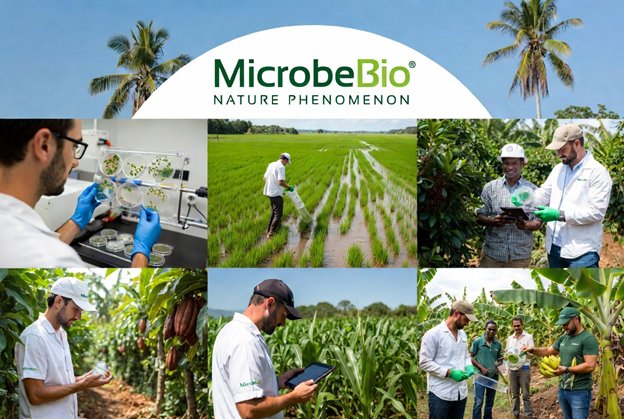
Dominican Republic Agriculture Sector Agriculture contributes approximately 4.5% of GDP and employs around 7.2% of the workforce. Key export crops include organic bananas (global leader with ~20,350 ha), cocoa (~153,000 ha with record exports), coffee, avocados, and expanding aquaculture.
Major Challenges
Soil degradation affecting ~69.7% of territory (erosion, nutrient depletion, microbial imbalance).
Water inefficiency (up to 70% losses in irrigation).
Heavy chemical dependency and pressure to meet stringent U.S./EU export standards.
The Cooperative Sector – A Unique Advantage The DR has approximately 2,300 cooperatives with nearly 2 million members. These organizations provide established infrastructure for collective purchasing, training, aggregation, and export market access — offering MicrobeBio an unmatched channel for rapid adoption and distribution.
MicrobeBio Differentiation MicrobeBio stands out through proprietary multi-strain consortia with documented efficacy, an integrated product + service model, deep cooperative partnerships, and blockchain traceability. This comprehensive approach addresses both agronomic needs and commercial traceability requirements.
4. Facility & Operations Plan
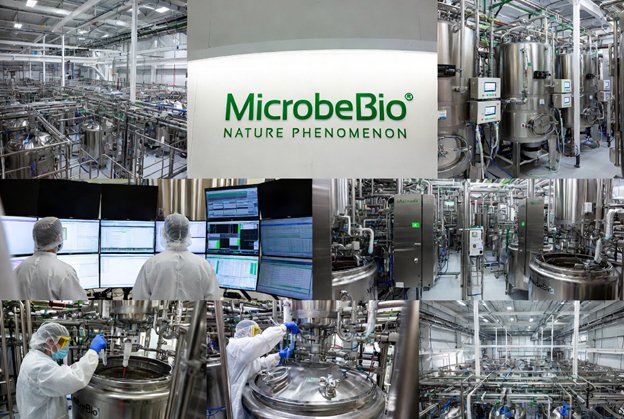
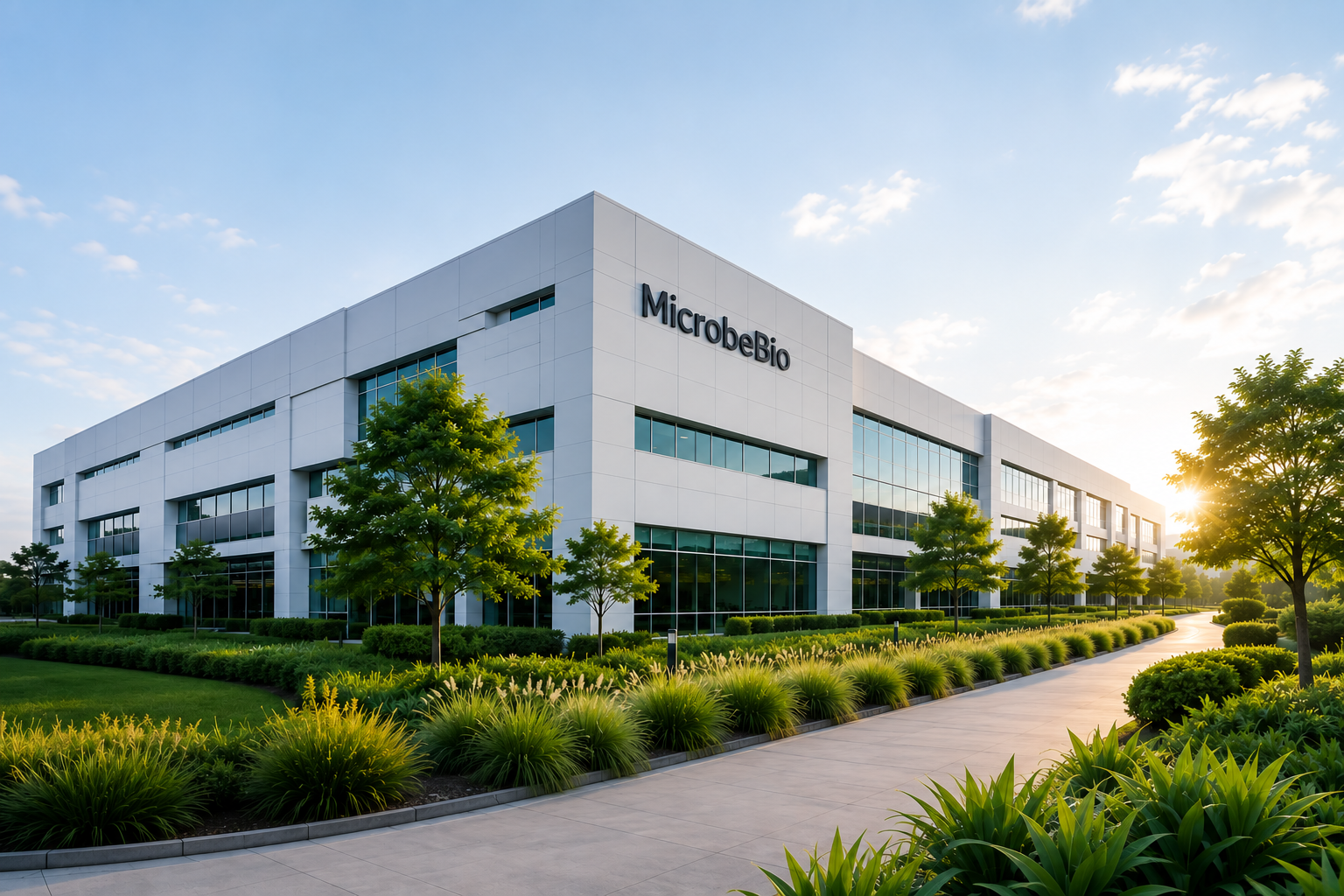
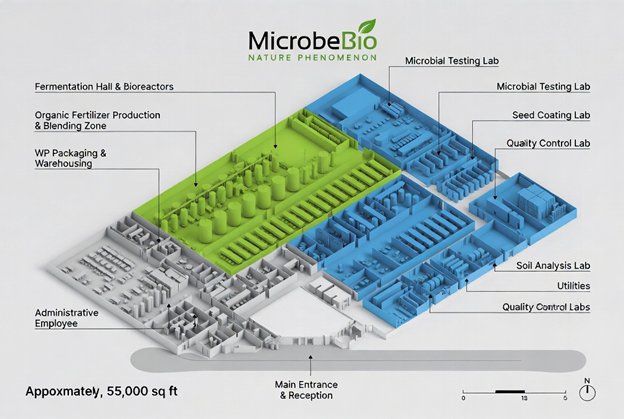
The proposed facility will be 50,000–70,000 square feet and located inside a Dominican Republic Free Zone. It will include dedicated fermentation halls, downstream processing areas (drying and milling), WP and liquid packaging lines, organic fertilizer production and custom blending zones, advanced R&D laboratories (soil and microbial testing, seed enhancement/coating, plant tissue culture), plus storage and administrative facilities.
Production Capacities:
Microbial WP formulations: up to 6,000 metric tons per year
Organic fertilizer: 20,000+ metric tons per year
Process Flow: Raw materials → Fermentation → Formulation → Drying/Milling → Quality Control → Packaging.
Technology & Sustainability State-of-the-art bioreactors, industrial dryers, and zero-waste design. Local raw material sourcing (poultry manure, Sargassum, bagasse) delivers cost advantages and supports circular economy goals.
Phased Rollout Conservative utilization ramp: 30% (Year 1), 60% (Year 2), 100% (Year 3) ensures quality and steady market buildup while maintaining product consistency.
5. Products & Services
WP Microbial Formulations:
Agriculture / High-Yield Pest & Disease Control: Broad-spectrum biopesticides and biofungicides using Bacillus thuringiensis, Trichoderma, Beauveria, Metarhizium, and proprietary consortia (up to 96% nematode reduction).
Soil Remediation & Restoration: Increases microbial diversity >3.5×, unlocks nutrients, and supports carbon sequestration.
Animal Health Probiotics, Water Cleaning & Black-Water Treatment, and Aquaculture Probiotics.
Cross-Cutting Benefits: Improved crop quality, protection of human and animal health, and prevention of waterway contamination.
Organic Fertilizers & Custom Blending Premium organic fertilizers (20,000+ MT/year) enriched with microbes, plus tailored blending services.
Laboratory Services Seed enhancement/coating, plant tissue culture, and comprehensive soil & microbial testing.
Pricing Strategy Microbial WP ~$20/kg (75% margin); organic fertilizers ~$0.90/kg (72% margin). Laboratory services provide additional high-margin recurring revenue.
6. Marketing, Sales & Distribution Strategy (Deep Cooperative Integration)
The MicrobeBio + Blockchain Agriculture Program elevates cooperatives to central operators and value-chain partners. Cooperatives will manage bulk procurement, farmer training, blockchain data entry, performance monitoring, and shared revenue participation.
3-System Ecosystem Model
MicrobeBio — Science-backed inputs and expertise.
Cooperative Network (~2,300 cooperatives) — Scale, trust, and execution capacity.
Blockchain Traceability — Immutable QR-code records for full transparency.
Value Proposition
Government: Higher export revenue, reduced chemical imports, improved farmer incomes.
Cooperatives: New revenue streams and stronger member outcomes.
Farmers: 20–40% yield gains, 10–35% price premiums, guaranteed buyers.
Pilot & Scale Phase 1 (6–12 months): 1–2 cooperatives, 1,000–5,000 farmers (cocoa, coffee, bananas). Year 1: DR rollout. Year 2–3: Regional expansion.
Farmer ROI Coffee (+62%), Cocoa (+65–66%), Banana (+50%). At 10,000 farmers, ecosystem revenue adds $10–25 million annually.
7. Organizational Structure & Management
The organization combines U.S. R&D leadership with local operational and partnership expertise. A dedicated Cooperative Partnership Division will oversee training and joint governance. University collaborations support technical extension. The project will create 100+ direct jobs with comprehensive training programs for cooperative members.
8. Regulatory, Legal & Environmental Compliance
The facility will operate under Law 8-90 Free Zone incentives, providing 100% exemptions on corporate income tax, import duties, VAT, and export taxes. Approvals will be secured from the Ministry of Agriculture, Ministry of Environment, CNZFE, and organic certification bodies. International standards (USDA, EU) will support exports.
9. Risk Analysis & Mitigation
Key risks (adoption, scaling, regulation) are mitigated by conservative ramp-up, deep cooperative integration, Free Zone benefits, pilot validation, and robust QA/blockchain systems. Sensitivity analysis is included in the Financial Plan.
10. Financial Plan & Model
CapEx Breakdown ($30 Million)
| Category | Amount ($M) | % |
| Land, Building & Infrastructure | 6.0 | 20% |
| Fermentation, WP Processing & Packaging | 10.5 | 35% |
| R&D Labs & Seed-Coating Equipment | 4.5 | 15% |
| Utilities & Sustainability Systems | 3.0 | 10% |
| Working Capital & Pilot Launch | 3.0 | 10% |
| Blockchain Integration & Training | 1.5 | 5% |
| Contingency | 1.5 | 5% |
| Total | 30.0 | 100% |
3-Year Financial Projections
| Metric | Year 1 (30%) | Year 2 (60%) | Year 3 (100%) |
| Total Revenue | $45,000,000 | $94,000,000 | $163,000,000 |
| Gross Profit | $33,300,000 | $69,560,000 | $120,620,000 |
| EBITDA | $17,124,000 | $36,660,000 | $64,596,000 |
| Net Profit | $15,124,000 | $34,660,000 | $62,596,000 |
Key Metrics
IRR: 48–58% (base ~52%)
Payback: 2.0–2.5 years
NPV: $65M–$85M+
Sensitivity Analysis (Year 3 EBITDA)
| Scenario | Utilization | Revenue | EBITDA | IRR |
| Best Case | 110% | $180M+ | $85M+ | 65%+ |
| Base Case | 100% | $163M | $64.6M | 52% |
| Worst Case | 80% | $130M | $48M | 35% |
Exit Strategy: Strategic sale or IPO at 8–12× EBITDA ($560M–$840M+ potential).
Conclusion
MicrobeBio’s Dominican Republic facility, powered by deep cooperative integration and the MicrobeBio + Blockchain Agriculture Program, delivers exceptional financial returns while creating a resilient, traceable agriculture ecosystem that benefits farmers, cooperatives, and the nation.
Long-Term Vision: Build Latin America’s premier cooperative-powered, fully traceable agriculture network — restoring soil, rebuilding futures, and delivering strong, sustainable returns.