Executive Summary
Two waste streams sit at the center of some of agriculture’s hardest problems: the residue left behind on farms after harvest, and the organic food waste generated after that food leaves the farm — in processing plants, grocery stores, restaurants, and homes. Both are burned, landfilled, or left to decompose in ways that release greenhouse gases, waste nutrients, and forfeit enormous economic and environmental value.
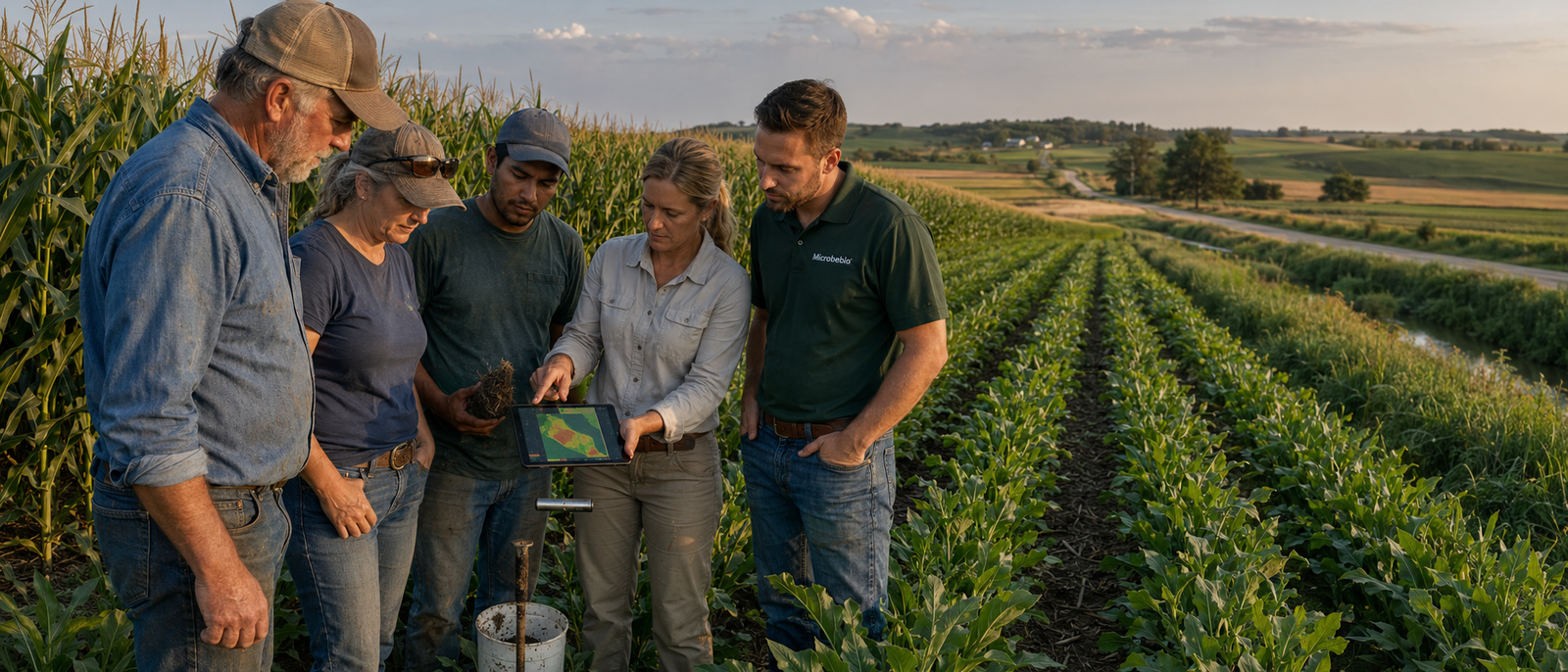
MicrobeBio’s proprietary waste-to-value technologies were built to close that gap. By combining stable, multi-strain microbial consortia with carbon-based processing methods, MicrobeBio converts both agricultural residue and organic food waste into biologically active soil health products — addressing fertilizer scarcity, water pollution and runoff, topsoil loss, declining biodiversity, and the climate cost of unmanaged organic waste, while supporting better outcomes for human and animal health.
This white paper lays out the scale of these connected problems, the science and proprietary technology behind MicrobeBio’s approach, its alignment with the USDA Regenerative Pilot Program, and the environmental, agronomic, and economic value the platform is designed to deliver.
Two Waste Streams, One Opportunity
Agricultural residue
Every harvest season, farms generate enormous volumes of crop residue, hulls, husks, and manure. Much of it is burned, hauled off, or left to decompose unevenly — releasing emissions and losing nutrients that could otherwise rebuild the soil.
Organic food waste
A second, equally significant waste stream begins where the farm ends. Food loss and waste occurs at every stage of the supply chain — processing byproducts, unsold retail inventory, restaurant scraps, and household food waste. Globally, a substantial share of all food produced is never eaten, and most of that waste is sent to landfills, where it decomposes anaerobically and generates methane, a greenhouse gas many times more potent than carbon dioxide over the short term.
One underlying opportunity
Treated separately, agricultural residue and organic food waste look like two different disposal problems. Treated through the same biological lens, they are the same opportunity: organic material rich in carbon and nutrients that, properly processed, can rebuild the soil it ultimately came from.
Addressing the Global Fertilizer Shortage
Global agriculture remains heavily dependent on synthetic fertilizer, a supply chain vulnerable to energy price shocks, geopolitical disruption, and raw material scarcity. Periods of tight fertilizer supply drive up input costs for farmers and threaten food production in the regions least able to absorb the shock.
MicrobeBio’s waste-to-value products offer a complementary, domestically producible alternative. By converting agricultural residue and organic food waste into microbial biofertilizers, compost-based amendments, and nutrient-rich soil products, MicrobeBio reduces a farm’s dependence on purchased synthetic fertilizer and creates a nutrient supply chain rooted in materials that are already local and already abundant — rather than materials that must be mined, manufactured, and shipped internationally.
This does not replace synthetic fertilizer outright, but it meaningfully eases the pressure on that supply chain, giving farmers a second, more resilient source of the nutrients their soil needs.
Water Quality, Runoff & Nutrient Loss
Nutrient runoff from farmland is one of agriculture’s most persistent water quality problems. When nutrients are applied faster than soil and crops can use them — or when soil structure is too degraded to hold water and nutrients in place — excess nitrogen and phosphorus wash into streams, rivers, and groundwater, contributing to algal blooms and degraded water quality downstream.
MicrobeBio’s products address this at its source, in two ways. First, biologically active soil amendments improve soil structure and water-holding capacity, so water infiltrates and is retained rather than running off the surface. Second, microbial and carbon-based amendments improve nutrient cycling efficiency, meaning more of the nitrogen and phosphorus applied to a field is taken up by the crop rather than lost to runoff or leaching.
The result is a double benefit: cleaner water leaving the farm, and more of the nutrient investment a farmer already made staying where it’s useful — in the root zone.
MicrobeBio’s Proprietary Waste-to-Value Technology Platform
MicrobeBio’s platform is built on proprietary microbial consortia and processing methods developed specifically to handle the variability of real-world waste streams — not the consistency of a lab sample.
Proprietary multi-strain microbial consortia
MicrobeBio’s core technology is a set of proprietary, multi-strain microbial consortia selected and combined for stability and performance across variable feedstocks. Rather than relying on a single organism suited to one narrow waste stream, these consortia are engineered to remain effective whether the input is crop stover, food processing byproduct, or manure.
Proprietary carbon-activation processes
MicrobeBio pairs its microbial technology with proprietary carbon-activation methods that convert raw organic material — including biochar-style and micronized carbon products — into stable, high-performance soil-building materials.
Proprietary compost and stabilization methods
MicrobeBio’s biological stabilization technology accelerates and standardizes the composting process, producing a more consistent, higher-quality finished product from feedstocks that would otherwise decompose unevenly on their own.
Why proprietary technology matters
Generic composting or residue management can produce inconsistent results because raw organic waste is inherently variable. MicrobeBio’s proprietary technologies are designed specifically to perform reliably despite that variability — which is what allows the same underlying platform to process both farm residue and food waste into a dependable, field-ready product.
The Science of Waste-to-Soil Value
Enhanced nutrient cycling and availability
Nutrients locked in residue or food waste become plant-available on a usable timeline instead of leaching, volatilizing, or sitting inert.
Increased microbial diversity and activity
A more diverse, active soil microbiome supports everything from disease suppression to nutrient exchange with plant roots.
Improved soil aggregation and organic matter
Carbon and biological activity build the physical structure that holds water, resists compaction, and resists erosion.
Greater resilience to erosion, drought, and stress
Soils with better structure and biology buffer crops against the swings that increasingly define modern growing seasons.
The MicrobeBio Platform Model
MicrobeBio’s proprietary technology moves both agricultural residue and organic food waste through the same repeatable model:
Waste Feedstock → Scientific Research & Validation → Production Development → Regenerative Products → Measurable Impact → Long-Term Value
01 — Waste feedstock
Agricultural residue and organic food waste both provide abundant, underutilized raw material for new soil health products.
02 — Scientific research & validation
Proprietary research and testing identify commercially viable, agronomically effective formulations for each feedstock type.
03 — Production development
Process engineering transforms validated research into consistent, scalable manufacturing.
04 — Regenerative products
Microbial inoculants, biochar, growing media, and related soil amendments support modern, resilient farming systems.
05 — Measurable impact
Environmental and agronomic performance is evaluated through transparent measurement and outcome tracking.
06 — Long-term value
Each product and each farm partnership builds soil capital, water quality, and economic value that compounds over successive growing seasons.
Rebuilding Topsoil and Soil Biodiversity
Decades of intensive tillage and synthetic-input-only farming have thinned and degraded topsoil across much of the world’s farmland, along with the biological diversity that topsoil depends on. Rebuilding it is a slow process under natural conditions — but biological inputs can accelerate it meaningfully.
Rebuilding topsoil
MicrobeBio’s carbon-based and microbial amendments add organic matter and biological activity directly back into degraded soil, helping rebuild the structure, depth, and fertility that erosion and years of intensive farming have worn away.
Building soil biodiversity
Healthy topsoil is a living system — bacteria, fungi, and other microorganisms that cycle nutrients, suppress disease, and support plant health. MicrobeBio’s multi-strain consortia reintroduce and support that biological diversity directly, rather than relying on synthetic inputs that can suppress microbial activity over time.
Carbon Offset and Climate Value
Diverting agricultural residue and organic food waste from open burning and landfill disposal carries direct climate value. Landfilled organic waste generates methane as it decomposes anaerobically; open-field burning releases carbon directly into the atmosphere along with particulate emissions.
MicrobeBio’s waste-to-value processing captures that carbon in a different form — stabilized in carbon-based soil amendments and organic matter that stores carbon in the soil rather than releasing it to the atmosphere. This dual effect — avoided emissions from the waste stream, plus carbon sequestered in the soil — positions MicrobeBio’s products to contribute to farm-level and regional carbon offset strategies as measurement and verification standards for soil carbon continue to mature.
Human and Animal Health Benefits
Human health
Soil health and food quality are connected. Soil with active, diverse microbial communities and balanced nutrient cycling supports crops with more consistent nutritional quality, and reduces reliance on synthetic chemical inputs whose runoff and residues carry their own downstream health considerations.
Animal health
On livestock operations, MicrobeBio’s biological processing of manure and organic waste supports better pathogen control during composting and stabilization, reducing the odor, fly pressure, and pathogen loads associated with poorly managed manure — conditions that affect both animal welfare and the health of workers and neighboring communities.
A connected system
Because MicrobeBio’s platform touches the food system at multiple points — the farm, the processing chain, and the waste stream — improvements at any one point tend to reinforce the others: healthier soil supports healthier crops, better-managed organic waste reduces environmental and health risk, and reduced synthetic input reliance lowers the broader chemical footprint of the food system.
Environmentally Friendly by Design
Every stage of MicrobeBio’s platform is built around reducing environmental impact rather than adding to it:
- Reduced open burning — residue diverted to productive use instead of the field.
- Reduced landfill methane — organic food waste processed biologically instead of buried.
- Reduced synthetic input reliance — biological products supplementing or replacing a portion of purchased fertilizer.
- Reduced water pollution — improved nutrient retention and reduced agricultural runoff.
- Increased carbon storage — carbon-based amendments that keep carbon in the soil rather than the atmosphere.
Market Opportunity
MicrobeBio is positioned across multiple high-growth sectors driving the shift toward regenerative agriculture and biological soil inputs.
| Market | 2025 | 2030 | 2035 | CAGR |
| Biofertilizers | $1.6B | $2.8B | $5.3B | 13% |
| Biostimulants | $4.5B | $7.8B | $15.5B | 12%* |
| Biochar | $0.9B | $1.8B | $3.6B | 15% |
| Growing Media | $6.9B | $8.3B | $9.8B | 3.6% |
| Soil Amendments | $8.6B | $13.5B | $21.2B | 9% |
| Organic Fertilizers | $14.0B | TBD† | $19.8B | 7%† |
* Based on the 2025 and 2035 figures shown, the implied 10-year CAGR for Biostimulants is approximately 13.2%, modestly above the 12% figure shown. † The 2030 Organic Fertilizers figure was incomplete in source materials and is marked TBD pending verification; the implied CAGR from the 2025 and 2035 figures is approximately 3.5%, which does not reconcile with the 7% figure shown. Both figures should be confirmed against the original market research source before external publication.
Direct Alignment with the USDA Regenerative Pilot Program
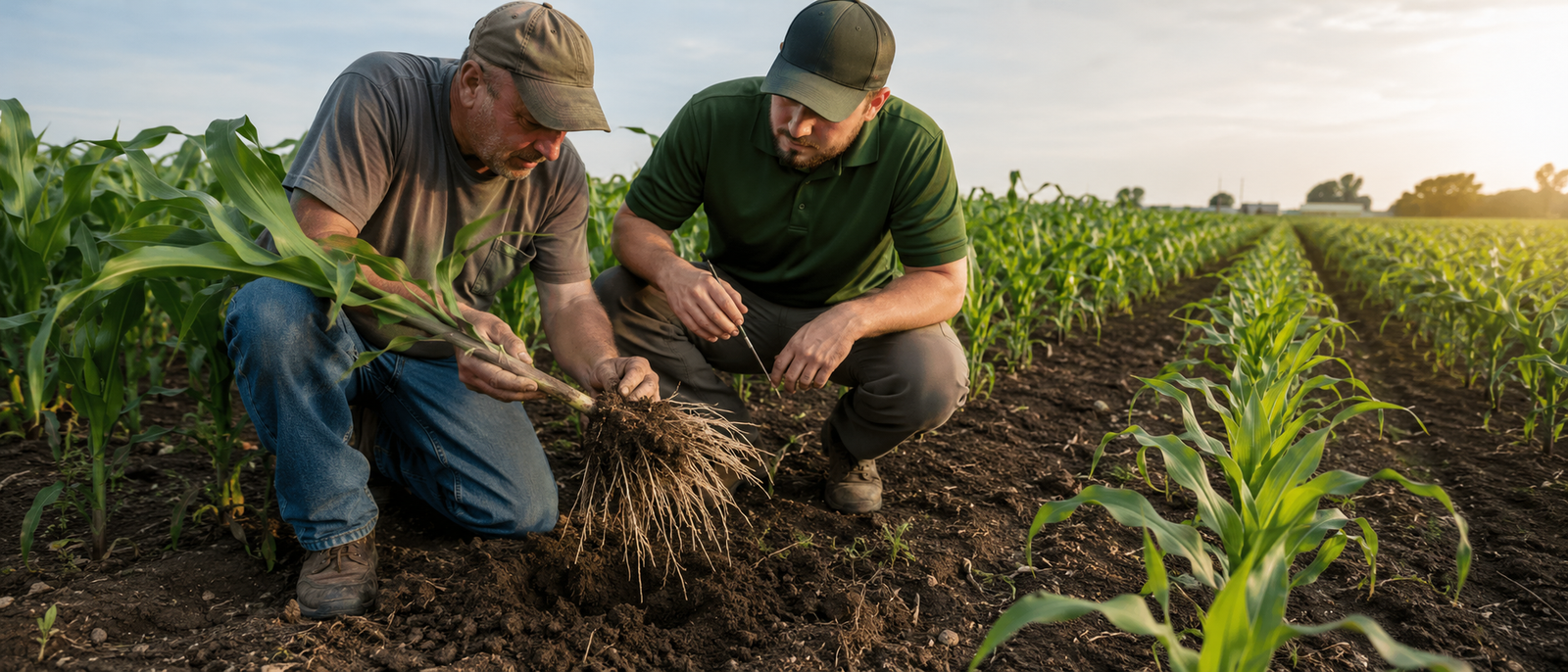
MicrobeBio’s approach maps directly onto the stated priorities of USDA’s Regenerative Pilot Program.
| USDA Regenerative Priority | MicrobeBio’s Contribution |
| Improve soil health | Rebuilds biology, organic matter, and structure using recycled nutrients and carbon from farm and food waste |
| Enhance water quality & management | Better nutrient retention and soil structure reduce runoff and improve water infiltration |
| Boost long-term productivity | Stronger soil function supports stable yields with lower reliance on synthetic inputs |
| Lower production costs | On-farm or regional conversion of waste reduces the need for purchased fertilizer |
| Whole-farm, outcomes-based planning | Creates closed-loop systems addressing soil, water, and input-cost goals through one strategy |
| Support beginning & established farmers | Offers practical, scalable tools that add value to waste streams farms already generate |
Practical Implementation Pathways
On-farm options
Farms can integrate MicrobeBio’s microbial activators directly into existing residue management, composting, or cover-crop systems.
Regional and cooperative models, including food waste diversion
Centralized or shared processing can convert both agricultural byproducts and regional organic food waste — from food processors, grocers, or municipal composting programs — into standardized, consistent soil amendments at scale.
Integration with NRCS conservation practices
MicrobeBio’s products complement existing NRCS conservation practices, including nutrient management, residue and tillage management, and soil carbon amendments.
Documentation and outcome tracking
Tracking soil test data, input reductions, and waste volumes processed helps producers document progress for EQIP, CSP, and whole-farm regenerative plan applications.
Economic and Farm-Level Value
- Lower input costs — better nutrient recovery reduces reliance on purchased synthetic fertilizer.
- New value from waste — material that was previously a cost center becomes an input with real value.
- Protected farm equity — soil that holds water and resists erosion protects long-term land value and productivity.
- Rural economic activity — regional waste processing and distribution supports local jobs beyond the farm gate.
Why Now: Structural Drivers
- Fertilizer supply pressure — global fertilizer markets remain vulnerable to price and supply shocks, increasing the value of alternative nutrient sources.
- Water quality regulation — growing attention to agricultural runoff is increasing demand for practices that reduce nutrient loss.
- Food waste awareness — food waste’s climate and resource cost is an increasing policy and corporate sustainability priority.
- Federal program support — USDA’s Regenerative Pilot Program and NRCS conservation programs are directing capital toward regenerative practices.
- Farm economics — rising input costs are increasing farmer interest in tools that reduce reliance on purchased fertilizer.
Impact Framework
Environmental value
- Reduced open burning and landfill methane from organic waste
- Reduced agricultural runoff and improved water quality
- Rebuilt topsoil and increased soil biodiversity
- Carbon stored in soil rather than released to the atmosphere
Health value
- Reduced synthetic chemical reliance across the food system
- Better pathogen control in manure and organic waste management
- More consistent soil and crop nutritional quality
Economic value
- Reduced fertilizer costs and exposure to fertilizer market volatility
- New value from previously discarded agricultural and food waste
- Stronger long-term farm productivity and land value
Recommendations
For producers: Evaluate residue and organic waste streams as soil health assets, and explore microbial conversion tools as part of whole-farm regenerative planning.
For NRCS staff and planners: Recognize waste-to-value biological systems as a complementary practice that advances soil, water, and climate resource concerns under the Regenerative Pilot Program framework.
For food and agricultural supply chain partners: Consider organic waste streams — processing byproducts, unsold inventory, and food scraps — as inputs for regional soil health production rather than disposal costs.
Call to action: Producers and partners interested in these approaches should engage their local NRCS office, request technical information on MicrobeBio’s waste-to-soil technologies, and integrate these tools into whole-farm and supply-chain sustainability strategies.
Conclusion
Agricultural residue and organic food waste are not two separate disposal problems — they are one connected opportunity. Left unmanaged, both waste streams degrade soil, pollute water, strain the global fertilizer supply, and add unnecessary greenhouse gas emissions to the atmosphere.
MicrobeBio’s proprietary waste-to-value technologies convert that shared problem into a shared solution: rebuilt topsoil, restored biodiversity, cleaner water, reduced fertilizer dependence, stored carbon, and a healthier connection between soil, food, and the people and animals who depend on both.
Turning farm and food waste into soil wealth.