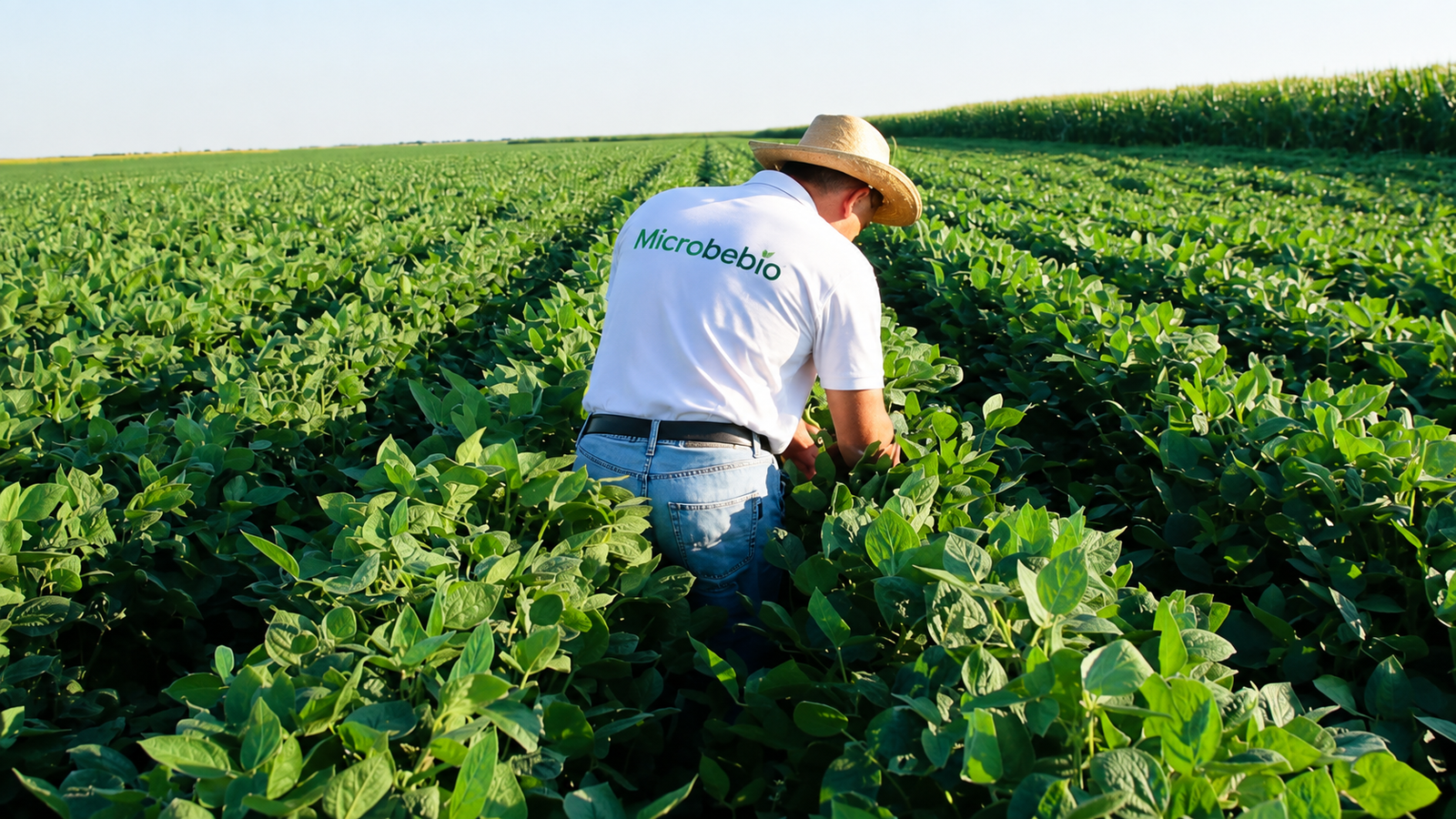
A Biological Framework for Productive Agriculture, Resource Efficiency, Climate Resilience, and Regenerative Growth
Agriculture stands at the intersection of some of the world’s most significant challenges: feeding a growing population, maintaining farmer profitability, protecting soil and water resources, adapting to climate variability, reducing environmental impact, and preserving the natural systems upon which food production ultimately depends.
Meeting these challenges requires more than producing additional agricultural inputs. It requires transforming how food is produced, how resources are used, and how agricultural productivity interacts with nature.
At MicrobeBio®, sustainability is not treated as a separate initiative. It is embedded within our scientific philosophy, technology development, and vision for the future of agriculture.
Our approach begins with a fundamental principle:
The world’s greatest agricultural and environmental challenges can increasingly be addressed by working with biology rather than against it.
MicrobeBio® develops biological technologies designed to harness beneficial microorganisms, plant–microbe interactions, soil biology, nutrient cycling, and other natural processes to support productive and resource-efficient agricultural systems.
Our sustainability strategy is organized around three interconnected pillars:
Pillar I — Transforming Food Systems
Develop biological technologies that can help agriculture produce more efficiently while improving nutrient utilization, soil function, crop performance, resource productivity, and food-system sustainability.
Pillar II — Enabling Farmer Resilience
Help farmers build stronger crops, healthier soils, more efficient production systems, and greater capacity to withstand economic and environmental pressures.
Pillar III — Partnering with Nature
Harness biological processes to regenerate soils, improve nutrient cycling, support biodiversity, conserve resources, and reduce agriculture’s environmental footprint.
Together, these pillars establish a framework through which MicrobeBio® seeks to advance a new agricultural model:
Productivity + Profitability + Regeneration + Resilience + Environmental Stewardship
1. Sustainability Through Biology
For much of modern agricultural history, productivity improvements have been driven by advances in genetics, mechanization, irrigation, fertilizers, crop protection, and agronomy.
These technologies have contributed enormously to global food security.
However, agriculture must now produce within increasingly complex constraints.
Farmers face rising fertilizer and energy costs, water scarcity, soil degradation, salinity, climate variability, pest and disease pressure, supply-chain volatility, and increasing expectations for environmental responsibility.
The next agricultural transformation therefore cannot focus solely on increasing inputs.
It must increasingly focus on improving biological efficiency.
MicrobeBio® believes that microorganisms and natural biological processes represent an important component of this transition.
Healthy agricultural ecosystems depend on relationships among:
Plants → Roots → Microorganisms → Soil → Nutrients → Water → Carbon → Biodiversity
Managing these relationships more effectively creates opportunities to improve productivity while reducing unnecessary resource losses.
2. The MicrobeBio® Sustainability Framework
Our three Sustainability Pillars are interconnected rather than independent.
Transforming Food Systems addresses the productivity and efficiency of agriculture at scale.
Enabling Farmer Resilience focuses on the people and businesses responsible for producing food.
Partnering with Nature focuses on the ecological systems that make agricultural production possible.
Together, they create a continuous sustainability cycle:
Healthy Natural Systems
↓
Healthy Soils
↓
Stronger Roots and Crops
↓
More Resilient Farmers
↓
More Efficient Food Production
↓
Greater Food-System Resilience
↓
Increased Capacity to Protect Natural Resources
This interconnected model is central to the MicrobeBio® philosophy.
PILLAR I
Transforming Food Systems
Producing More Value From Agricultural Resources
Food-system transformation begins at the farm.
The efficiency with which crops convert soil, nutrients, water, sunlight, carbon dioxide, biological activity, and agricultural inputs into food ultimately influences the environmental and economic performance of the entire food system.
MicrobeBio® seeks to help improve this conversion through biological innovation.
Our technologies are designed to complement modern agronomy by supporting biological processes associated with nutrient cycling, root development, plant nutrition, soil health, and crop performance.
3. Improving Nutrient-Use Efficiency
Fertilizers are essential to global food production, but nutrients applied to agricultural land are not always completely captured by crops.
Nitrogen can potentially be lost through leaching, volatilization, runoff, or denitrification.
Phosphorus can become associated with soil minerals and become less immediately available.
Micronutrients can also become inaccessible because of soil chemistry, pH, moisture, and mineral interactions.
Beneficial microorganisms can participate in processes including:
-
biological nitrogen cycling;
-
phosphorus solubilization;
-
nutrient mineralization;
-
organic matter decomposition;
-
micronutrient mobilization; and
-
rhizosphere nutrient transformations.
MicrobeBio® technologies are designed to support these biological functions.
The objective is not simply:
Apply more fertilizer.
It is:
Make Every Unit of Fertilizer Count.
Improved nutrient efficiency can potentially support agricultural productivity while helping reduce unnecessary nutrient losses.
4. Building the Biological Foundation of Crop Production
Plants do not grow independently from their soil microbiome.
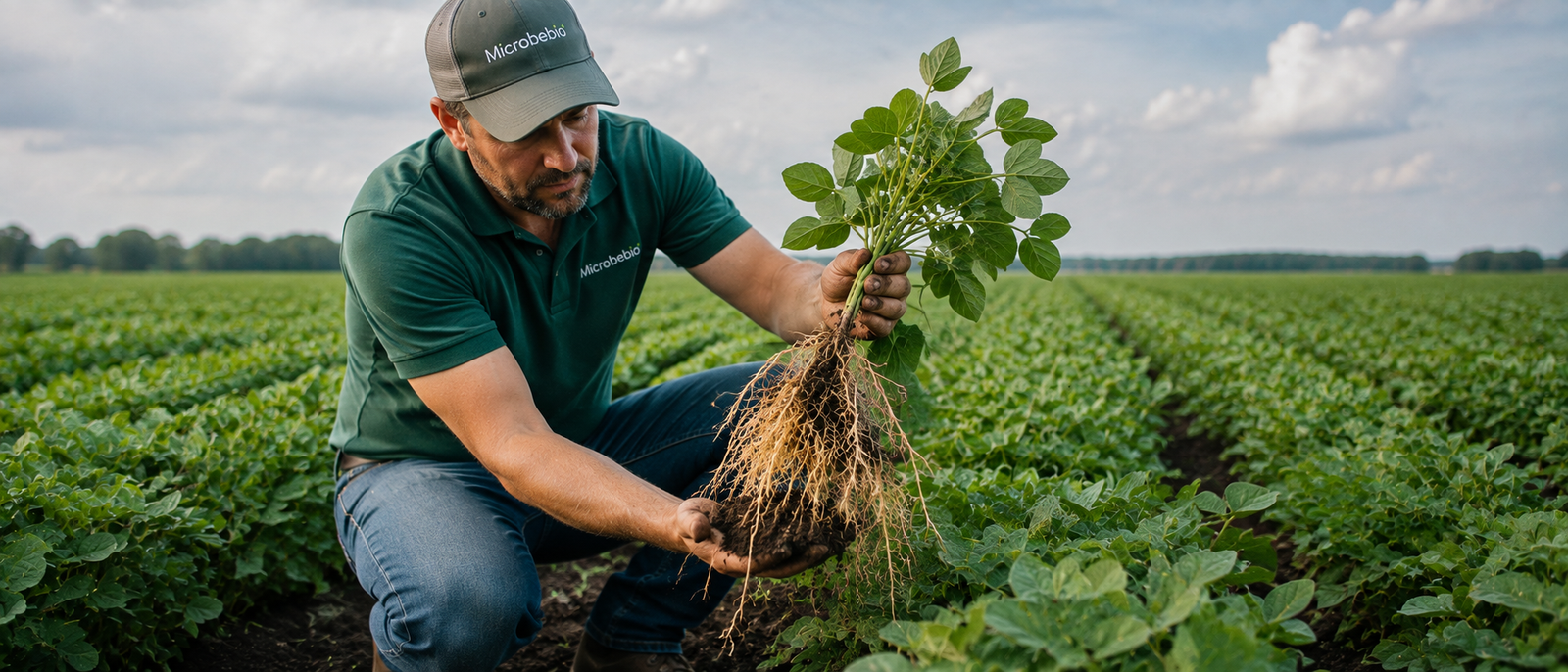
The rhizosphere—the biologically active zone surrounding roots—contains complex communities of microorganisms interacting continuously with plants.
These microorganisms can influence nutrient cycling, root development, organic matter transformation, mineral availability, and plant–soil relationships.
MicrobeBio® seeks to strengthen this biological foundation.
The agricultural system can therefore evolve from:
Fertilizer → Crop
toward:
Soil + Biology + Roots + Nutrition + Water + Crop Management → Productive Agriculture
This integrated approach represents an important component of sustainable food-system transformation.
5. Supporting Greater Productivity From Existing Farmland
Expanding agricultural production through continual conversion of natural ecosystems creates significant environmental pressure.
One pathway toward greater food security is therefore to improve the productivity and resilience of land already under cultivation.
Biological technologies may contribute by supporting:
better establishment, stronger root systems, nutrient efficiency, soil function, water access, plant vigor, yield potential, and crop quality.
When greater marketable output can be produced efficiently from existing agricultural land, pressure to expand production into environmentally sensitive areas may potentially be reduced.
6. Improving Crop Quality and Food-System Value
Sustainable food production is not measured only in tonnes harvested.
Crop quality, uniformity, nutritional management, marketability, postharvest characteristics, and economic value also influence food-system efficiency.
Agricultural production that generates high levels of unmarketable output wastes the land, water, fertilizer, labor, energy, and transportation invested in that crop.
MicrobeBio® therefore views crop quality and resource efficiency as interconnected sustainability objectives.
7. Supporting the Transition Toward Biological Agriculture
MicrobeBio® does not view biological agriculture as the rejection of modern agricultural science.
Instead, we envision the next generation of agriculture as the integration of:
Biotechnology + Agronomy + Genetics + Precision Agriculture + Soil Science + Plant Nutrition + Data + Water Management
Biology becomes another powerful layer of agricultural technology.
The objective is to combine the productivity of modern farming with a deeper understanding of natural biological systems.
PILLAR II
Enabling Farmer Resilience
Sustainability Must Also Be Economically Sustainable
There can be no sustainable agricultural system without economically sustainable farmers.
Farmers operate businesses exposed simultaneously to biological, climatic, financial, and market risk.
Their costs can increase rapidly while commodity prices remain uncertain.
They face unpredictable weather, pests, diseases, water limitations, fertilizer volatility, labor shortages, transportation costs, and changing market requirements.
For MicrobeBio®, farmer resilience means helping producers build agricultural systems capable of performing under these increasingly demanding conditions.
8. Improving Input Efficiency
One of the most direct pathways to greater farmer resilience is improving the productive value generated from agricultural inputs.
Fertilizer, irrigation, crop protection, fuel, labor, and equipment represent substantial investments.
Biological technologies should therefore be evaluated not only by their purchase price but by their contribution to:
yield, quality, resource efficiency, risk reduction, and return on investment.
MicrobeBio® seeks to help growers move from an input-volume model toward an input-efficiency model.
The question becomes:
How much productive crop value can be generated from each dollar invested?
9. Building Stronger Root Systems
Crop resilience begins below ground.
A deeper and more extensively distributed root system can explore a greater volume of soil for water and nutrients.
This can become particularly important during:
-
drought;
-
irregular rainfall;
-
heat stress;
-
nutrient limitations;
-
transplant establishment; and
-
periods of high crop demand.
MicrobeBio® biological technologies are designed to support a healthier rhizosphere and stronger root development.
Stronger Roots
↓
Greater Soil Exploration
↓
Greater Access to Water and Nutrients
↓
Stronger Crop Establishment
↓
Greater Production Resilience
10. Supporting Water Productivity
Water scarcity is becoming one of agriculture’s defining challenges.
Agriculture must increasingly produce greater crop value from each unit of available water.
Root development, soil structure, organic matter, microbial activity, irrigation management, and crop genetics all influence water productivity.
MicrobeBio® seeks to support the biological components of this system.
Biologically functional soils combined with appropriate management may support improved soil aggregation, infiltration, root penetration, and soil–water relationships.
The objective is not simply to irrigate more.
It is to help agriculture use water more intelligently.
11. Resilience to Climate Variability
Climate variability can expose crops to combinations of drought, heat, flooding, salinity, and unpredictable growing conditions.
Biological technologies cannot eliminate climatic risk.
However, healthier soils, more extensive root systems, improved nutrient access, and stronger crop establishment can contribute to more resilient production systems.
MicrobeBio® therefore views biological soil management as part of a broader climate-adaptation strategy.
12. Protecting Farmer Profitability
Sustainability initiatives that cannot deliver economic value are difficult to scale.
MicrobeBio® believes biological technologies must demonstrate measurable value at the farm level.
Relevant performance indicators can include:
-
yield per hectare;
-
marketable yield;
-
crop quality;
-
fertilizer-use efficiency;
-
water-use efficiency;
-
root development;
-
cost per tonne produced;
-
production consistency;
-
input savings where validated; and
-
return on investment.
Our objective is to make sustainability economically meaningful for farmers.
13. Supporting Smallholders and Large-Scale Agriculture
The sustainability challenge spans every scale of agriculture.
Smallholder farmers require technologies that can improve productivity and income while remaining practical and accessible.
Large agricultural enterprises require scalable technologies capable of integration with sophisticated fertility, irrigation, mechanization, and precision-agriculture systems.
MicrobeBio® technologies are intended to support both models through adaptable biological programs designed around local crops, soils, climates, and production systems.
PILLAR III
Partnering with Nature
Agriculture Depends on Natural Capital
Soil, water, biodiversity, microorganisms, carbon cycles, and nutrient cycles are not external to agriculture.
They are its foundation.
MicrobeBio® believes long-term agricultural productivity depends on maintaining and restoring these biological resources.
Partnering with nature means understanding natural systems and using biotechnology to strengthen rather than unnecessarily disrupt them.
14. Restoring the Living Soil
Soil is one of Earth’s most valuable biological resources.
Healthy soil contains extraordinarily complex communities of microorganisms that participate in nutrient cycling, decomposition, aggregation, carbon transformation, and plant development.
MicrobeBio® technologies are designed to support this living component of agricultural soil.
Our goal is to help move agricultural management from viewing soil simply as a physical growing medium toward recognizing it as a living biological ecosystem.
15. Supporting Soil Organic Matter
Organic matter contributes to many important soil functions, including:
-
nutrient retention;
-
soil aggregation;
-
water-holding characteristics;
-
microbial habitat;
-
cation exchange capacity;
-
erosion resistance; and
-
carbon storage.
Microorganisms play important roles in decomposing plant residues and transforming organic materials.
MicrobeBio® biological programs can be integrated with crop residues, composts, organic amendments, cover crops, and regenerative management practices to support soil biological activity and nutrient cycling.
16. Agriculture and the Carbon Cycle
Agriculture is fundamentally connected to the global carbon cycle.
Plants capture atmospheric carbon dioxide through photosynthesis and convert it into biomass.
A portion of this carbon enters the soil through roots, root exudates, crop residues, and microbial biomass.
Microorganisms then participate in transforming these carbon compounds.
Supporting productive crops, extensive root systems, soil cover, organic matter management, and active soil biology can therefore contribute to healthier soil carbon cycling.
MicrobeBio® sees biological agriculture as one component of a broader strategy for improving soil function and long-term carbon stewardship.
Specific carbon sequestration claims, however, should be quantified through appropriate field measurement and scientifically validated methodologies.
17. Protecting Water Resources
Efficient agriculture must protect both water quantity and water quality.
Improved nutrient management can help reduce the risk of nutrient movement beyond productive agricultural systems.
Healthy soils can also contribute to improved infiltration and reduced erosion when combined with appropriate conservation practices.
MicrobeBio® seeks to support agricultural systems that produce greater value from water while helping minimize unnecessary nutrient and sediment losses.
18. Supporting Agricultural Biodiversity
Biodiversity exists not only above ground but below it.
Agricultural soils contain complex microbial ecosystems that influence plant health and ecosystem function.
MicrobeBio® focuses particularly on this invisible biological diversity.
By supporting beneficial microbial communities and biological soil function, we seek to strengthen the biological foundation upon which productive agriculture depends.
19. Advancing the Circular Bioeconomy
Nature produces very little true waste.
One organism’s by-product becomes another organism’s resource.
MicrobeBio® applies this biological principle to the emerging circular bioeconomy.
Organic residues, agricultural by-products, compostable materials, and recovered nutrients can potentially be transformed into higher-value agricultural resources through appropriate biological and manufacturing technologies.
The model evolves from:
Take → Use → Dispose
toward:
Recover → Transform → Reuse → Regenerate
This approach can reduce waste while returning valuable biological and nutritional resources to productive use.
20. Reducing Dependence Through Biological Efficiency
Modern fertilizers and crop-protection technologies remain important components of global agriculture.
The MicrobeBio® sustainability objective is not to make unsupported claims that biological technologies can universally replace them.
Instead, our goal is to develop systems capable of reducing unnecessary dependence through improved biological efficiency wherever scientifically and agronomically validated.
That distinction is important.
Sustainable agriculture requires measurable performance, not ideology.
21. Three Pillars — One Integrated System
The three MicrobeBio® Sustainability Pillars reinforce one another.
TRANSFORMING FOOD SYSTEMS
Improve agricultural productivity and resource efficiency
↓
ENABLING FARMER RESILIENCE
Strengthen farm economics and production stability
↓
PARTNERING WITH NATURE
Protect and regenerate the biological resources agriculture depends upon
↓
SUSTAINABLE AGRICULTURAL GROWTH
This creates a model in which productivity, profitability, and environmental stewardship are not competing objectives.
They become interconnected outcomes.
22. Measuring Sustainability
Sustainability must ultimately be measurable.
MicrobeBio® supports the development of field-based metrics that can quantify biological, agronomic, environmental, and economic performance.
Depending on the project, these may include:
Agricultural Performance
Yield, marketable yield, crop quality, plant vigor, root mass, and production consistency.
Nutrient Efficiency
Nutrient-use efficiency, fertilizer productivity, plant tissue nutrition, and nutrient availability.
Soil Health
Organic matter, soil carbon, biological activity, aggregation, root-zone characteristics, and relevant soil-health indicators.
Water
Water-use efficiency, irrigation productivity, infiltration, and soil moisture characteristics.
Environmental Performance
Nutrient losses, erosion risk, waste recovery, resource recycling, and scientifically validated carbon indicators.
Farmer Economics
Input costs, cost per hectare, cost per tonne produced, gross margin, profitability, and return on investment.
Measurement transforms sustainability from an aspiration into an operational agricultural strategy.
23. Supporting Global Sustainability Priorities
The MicrobeBio® sustainability framework can contribute to broader global objectives involving:
Food Security — supporting productive agricultural systems.
Soil Health — strengthening biological and physical soil function.
Water Stewardship — improving agricultural water productivity.
Climate Resilience — helping agricultural systems adapt to environmental variability.
Resource Efficiency — increasing productive value generated from fertilizers, water, land, and organic resources.
Circular Bioeconomy — recovering and transforming biological resources.
Biodiversity — supporting the biological foundations of agricultural ecosystems.
Farmer Prosperity — ensuring sustainability creates measurable economic value for producers.
24. Our Sustainability Vision
MicrobeBio® envisions an agricultural future in which advanced biotechnology and natural biological processes operate together.
A future where:
Farmers produce more efficiently.
Plants develop stronger biological foundations.
Fertilizers generate greater productive value.
Water is managed more efficiently.
Soils become biologically healthier.
Organic resources are recovered rather than wasted.
Agriculture becomes more resilient to environmental change.
And productivity increasingly works in partnership with nature.
This is not simply about replacing one agricultural input with another.
It represents a broader transformation in how agricultural productivity is understood.
25. Conclusion
The future of agriculture must simultaneously address food security, farmer profitability, environmental stewardship, and climate resilience.
These objectives cannot be achieved independently.
MicrobeBio® therefore organizes its sustainability strategy around three interconnected commitments:
Transforming Food Systems
Using biological innovation to help produce food more efficiently and improve the productive value of agricultural resources.
Enabling Farmer Resilience
Helping farmers strengthen roots, crops, soils, resource efficiency, productivity, and economic resilience.
Partnering with Nature
Harnessing microorganisms and natural biological processes to support soil health, nutrient cycling, water stewardship, biodiversity, carbon cycling, and regenerative agriculture.
Together, these pillars represent the MicrobeBio® vision for the future:
Produce More Efficiently.
Strengthen Farmers.
Regenerate Natural Systems.
Because the future of sustainable agriculture will not be built by choosing between productivity and nature.
It will be built by learning how to make them work together.
MicrobeBio®
Biology Working for a More Sustainable World™
Transforming Food Systems
Enabling Farmer Resilience
Partnering with Nature
Agriculture • Soil Health • Biological Nutrition • Crop Protection • Water Stewardship • Climate Resilience • Circular Bioeconomy • Environmental Biotechnology
Better Biology. Healthier Soil. Stronger Farmers. A More Sustainable Future.