
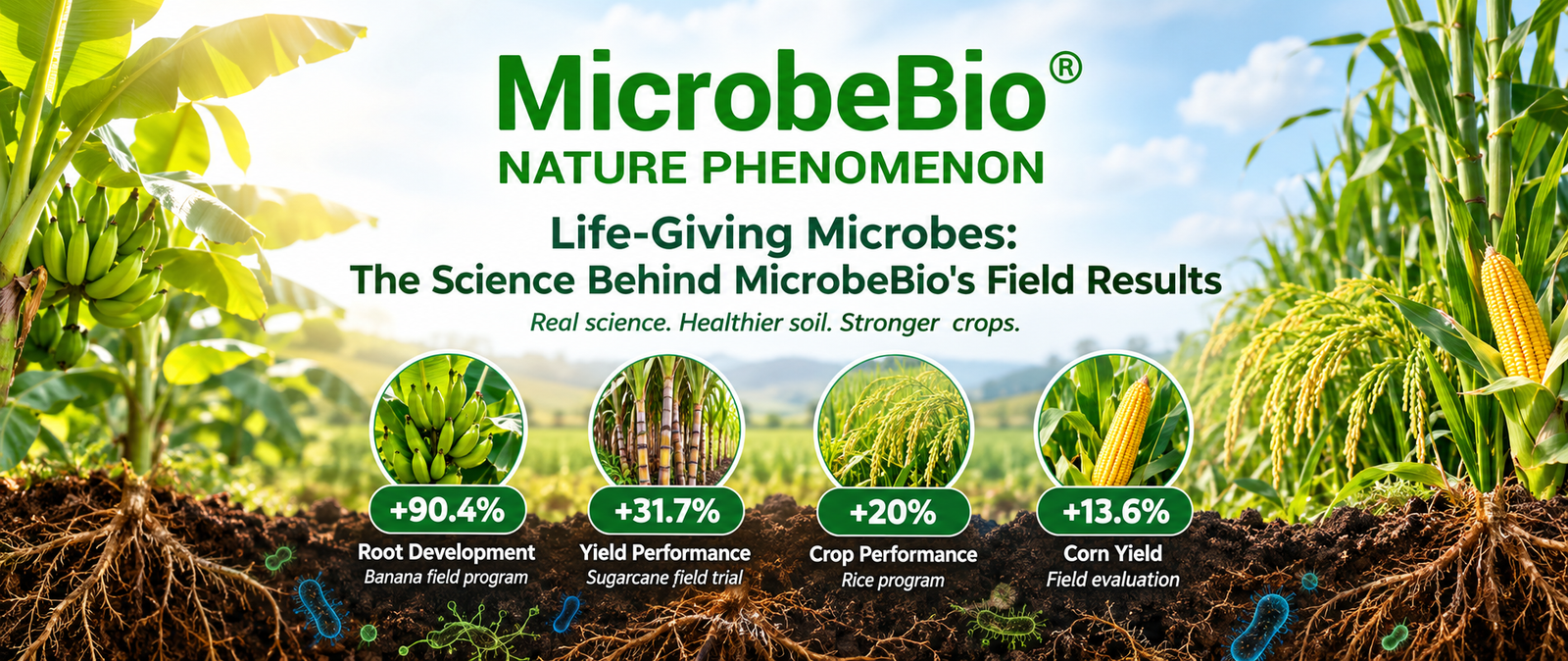
Life-Giving Microbes: The Science Behind MicrobeBio's Field Results
Why the world’s most advanced growers are turning to biology — and what the research says about it.
There’s a reason MicrobeBio calls it Biology Rising™. For over two decades, we’ve believed that the next leap in agriculture won’t come from another bag of synthetic fertilizer — it’ll come from the trillions of microorganisms already living in the soil beneath our feet, working exactly the way nature designed them to.
We didn’t invent nitrogen fixation, phosphate solubilization, or mycorrhizal symbiosis. Scientists have been publishing on these mechanisms for decades. What we do is something different: we identify, select, and combine over 50 strains of the right beneficial microbes — Bacillus, Pseudomonas, Trichoderma, Azospirillum, arbuscular mycorrhizal fungi, and more — into proprietary formulas engineered to survive shipping, storage, and the realities of a working farm.
Here’s a look at the biology behind our four flagship results, and the growing body of independent, peer-reviewed research that backs up what growers are seeing in the field.
Banana Programs: +90.4% Root Development
Healthy bananas start below the soil line. Our banana field program is built around PGPR strains that colonize the root zone, produce natural phytohormones, and physically stimulate roots to branch, thicken, and dig deeper for water and nutrients.
The independent science: A published controlled trial on banana seedlings inoculated with PGPR strains (Azospirillum brasilense and Bacillus species — close relatives of strains in the MicrobeBio formula) measured root volume increases of up to 168% and root mass increases of up to 141% compared to untreated plants.¹ Bigger roots mean more surface area to pull in water and nutrients — which is exactly the foundation our banana program is built to deliver.
Sugarcane: +31.7% Yield Performance
Sugarcane is a heavy feeder, and even small gains in nutrient efficiency compound into real tonnage at harvest. Our sugarcane formula leans on nitrogen-fixing and phosphate-solubilizing bacteria to keep nutrients flowing to the stalk all season long.
The independent science: A multi-site field study using a biofertilizer built on Pseudomonas fluorescens, Azospirillum brasilense, and Bacillus subtilis — the same species families found in MicrobeBio’s microbial library — recorded sugarcane yield increases ranging from 40% to 150% across three independent growing regions, with the authors describing the results as “highly reproducible.”² Our own field number of +31.7% sits well within what’s scientifically achievable for this technology.
Rice: +20% Crop Performance
Rice growers face a tight margin between input costs and returns. Our rice program is designed to help close that gap by putting biology to work on nutrient efficiency and root health, season after season.
The independent science: A two-year, independently conducted field trial on biofertilizer-treated rice found a 20.1% increase in total biomass yield over untreated plots — remarkably close to the field results MicrobeBio growers report.³ The same study noted low year-to-year variability, meaning these are gains growers can count on.
Corn: +13.6% Yield in Field Evaluation
More kernels per ear, healthier stands, and better nutrient uptake — that’s the goal of every corn application. Our formula draws on the same Bacillus and Trichoderma biology that independent researchers have been field-testing on maize for years.
The independent science: A three-year, two-site field study of a composite microbial fertilizer built on Bacillus subtilis and Trichoderma harzianum — both organisms represented in MicrobeBio’s proprietary consortia — reported maize yield increases of up to 11.4%.⁴ A separate replicated field trial of a comparable microbial consortium product measured a 14% corn yield increase in furrow application alongside standard fertility programs.⁵ Our own average of +13.6% lands right in the middle of that range.
The Bigger Picture: Why Biology Works
None of this is a coincidence. Nitrogen fixation, phosphate solubilization, phytohormone production, and mycorrhizal symbiosis are among the most heavily studied processes in soil microbiology — and the more researchers look, the more they confirm what MicrobeBio has believed since day one: healthy biology grows healthy crops.
That’s why our formulas don’t rely on a single silver-bullet strain. We build multi-functional consortia — nitrogen fixers, phosphate solubilizers, phytohormone producers, and beneficial fungi working together in the rhizosphere — because the research consistently shows that plants respond to systems, not single ingredients.
From Lab to Field
Every MicrobeBio product moves through the same disciplined pipeline before it ever reaches a grower:
Research Institute → Microbial Culture Library → Fermentation → Formulation → Manufacturing → Field Validation → Global Distribution
It’s the same commitment to sustainable, regenerative agriculture that’s guided us for more than two decades — and it’s why growers across North America, Latin America, Asia, and beyond trust MicrobeBio to help them produce more, waste less, and regenerate the soil their operations depend on.
 Ready to see what biology can do for your crop?
Reach out to our team to talk about a program tailored to your soil, your crop, and your goals — or contact us for a free trial test to see the results for yourself.
¹ Mia, M.A.B. et al. (2010), effect of PGPR inoculation on banana root development, Malaysian Journal of Applied Biology.
² Independent multi-site sugarcane biofertilizer study, Heliyon (2024).
³ Independent two-year rice biofertilizer field trial, Frontiers in Sustainable Food Systems (2026).
⁴ Independent maize field study using Bacillus subtilis and Trichoderma harzianum, PMC (2025/26).
⁵ Replicated corn field trial, U.S. patent filing on microbial consortia formulations.
These studies reflect independent, third-party research on comparable microbial technologies and are cited here to illustrate the scientific basis for MicrobeBio’s approach; they are not studies of MicrobeBio’s proprietary formulations.