Turning Farm and Food
Waste Into Soil Wealth
A MicrobeBio® White Paper
Transforming Organic Waste Streams Into Biological Resources for Healthier Soils,
More Resilient Agriculture, and a Circular Bioeconomy
THE PROBLEM • TECHNOLOGY • PLATFORM • MODEL • IMPACT
Waste is not the end of the cycle.
It is raw material for the next one.
Agriculture faces two challenges that are often treated separately.
The first is waste.
Crop residues, rejected produce, food-processing by-products, plant material, and other organic resources are generated throughout the agricultural and food supply chain. When these materials are poorly managed or sent to landfill, their remaining carbon and nutrients can be lost from productive use.
The second is soil degradation.
Agricultural soils need organic matter, biological activity, efficient nutrient cycling, good soil structure, and sufficient water-holding capacity to remain productive over the long term.
MicrobeBio® sees an opportunity to connect these challenges.
Waste should not be the end of the agricultural cycle. It can become the beginning of the next one.
MicrobeBio’s vision is to develop biological systems that support the transformation of suitable farm and food organic residuals into useful soil resources.
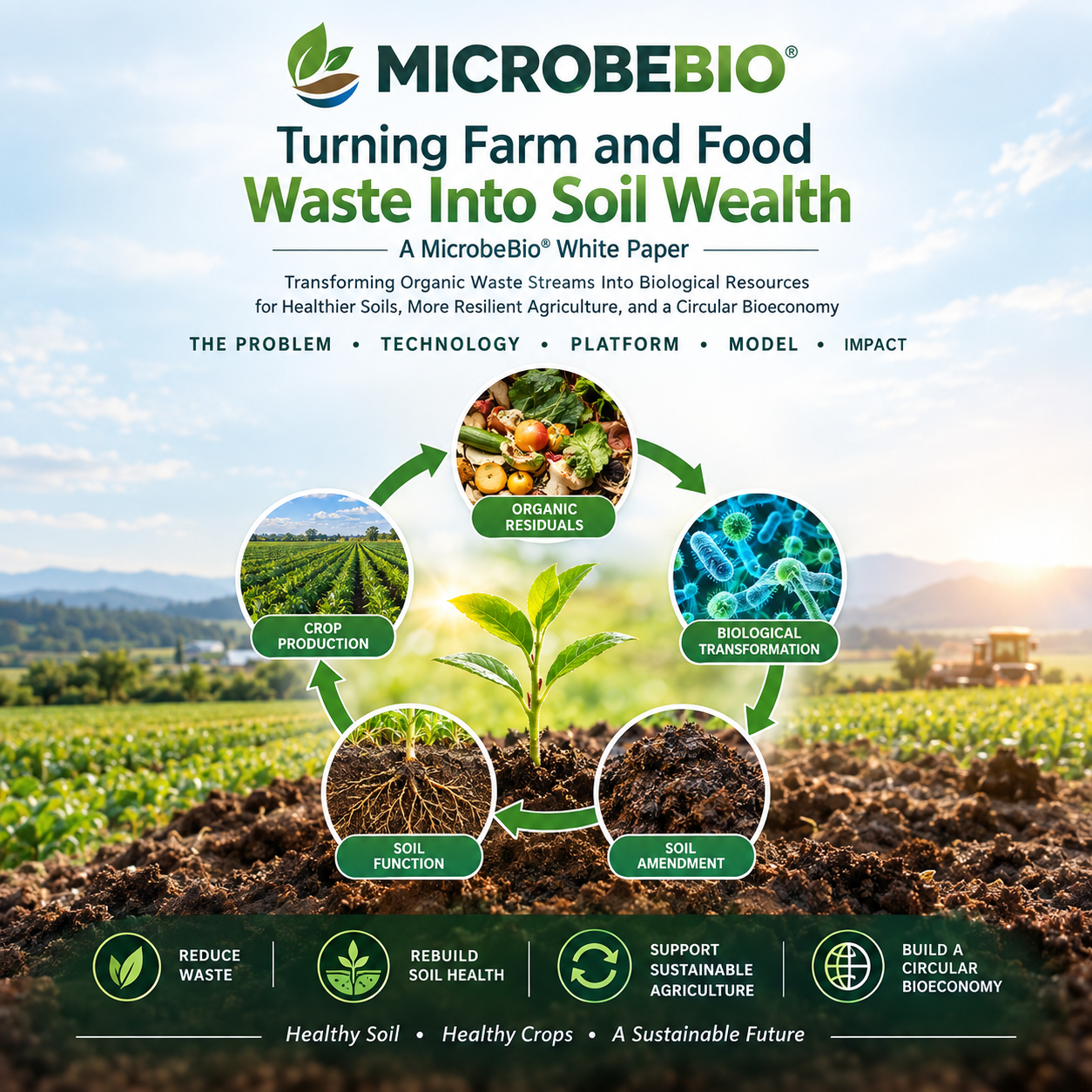
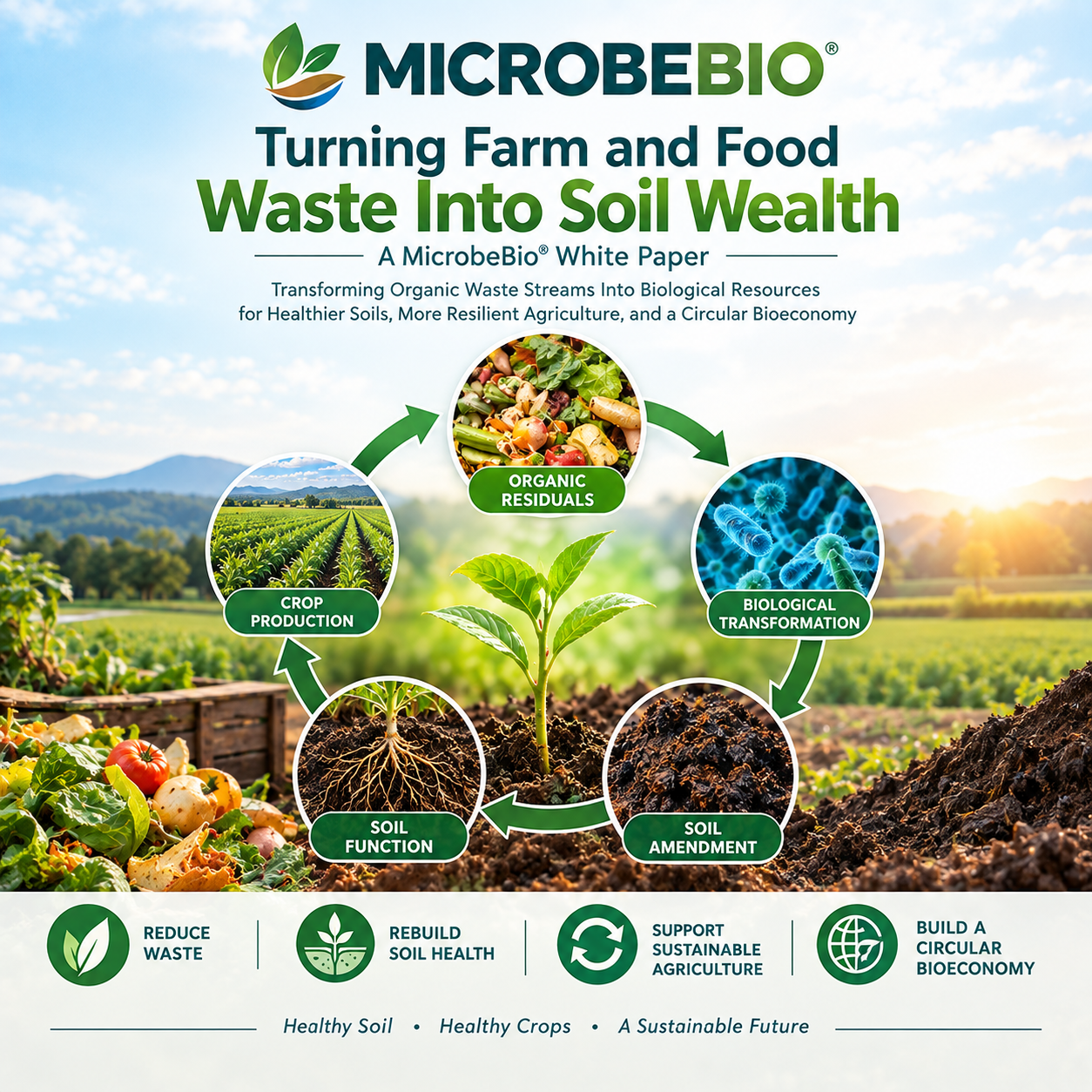
Organic Residuals → Biological Transformation → Soil Amendment → Soil Function → Crop Production → New Organic Residuals
Rather than viewing agricultural organic material exclusively as something to dispose of, the MicrobeBio model views appropriate, properly characterized organic streams as potential sources of carbon, nutrients, and biological feedstock.
The objective is not merely waste reduction. It is resource recovery. It is about returning value to soil. It is about turning farm and food waste into soil wealth.
 01 | THE PROBLEM
We Are Throwing Away Resources That Soil Needs
Modern agriculture operates within an increasingly linear system. Resources are extracted. Inputs are manufactured. Crops are produced. Food is processed. Organic residuals are generated. Much of that material leaves the productive agricultural cycle.
At the same time, many agricultural soils face declining organic matter, erosion, compaction, inefficient nutrient cycling, reduced biological diversity, and increasing vulnerability to drought and extreme rainfall.
Organic carbon and nutrients leave farms and food systems as waste while farmers must continually purchase inputs to maintain soil productivity.
EPA describes composting as managed aerobic biological decomposition by microorganisms and recognizes compost as a valuable, biologically stable soil amendment that can recycle organic matter and nutrients back to soil.
The Waste Problem
- Crop residues and plant biomass
- Fruit and vegetable processing residuals
- Rejected or unsold produce
- Food-processing by-products
- Selected manure and animal-production organic material
- Landscape and plant residues
- Other clean, source-separated biodegradable materials
Not every waste stream should be applied to agricultural land. Contamination, pathogens, salts, nutrient loading, pesticide residues, heavy metals, plastics and other hazards must be evaluated. Where suitable feedstocks can be safely recovered, however, they can potentially become part of a biological resource cycle.
The Soil Problem
Healthy agricultural soil is more than minerals. It is a living system composed of mineral particles, organic matter, water, air, plant roots, microorganisms and larger soil organisms interacting continuously.
Organic matter and properly managed compost can support soil structure, water infiltration and retention, nutrient cycling, fertility and beneficial soil organisms.
- Capture more water
- Cycle nutrients more effectively
- Support greater biological activity
- Resist erosion
- Support stronger root systems
- Withstand environmental stress more effectively
How much of that organic resource can safely be transformed and returned to productive soil?
02 | THE TECHNOLOGY
Biology Is Nature’s Recycling Technology
Decomposition is fundamentally biological. Microorganisms consume, transform and mineralize organic materials. Through these processes, complex organic compounds can be progressively converted into simpler compounds, stable organic matter and biologically cycled nutrients.
Instead of replacing biology, activate it.
A biological transformation system can be designed around selected functional microorganisms and appropriate process conditions.
Organic-Matter Decomposition
Microorganisms capable of producing cellulases and other enzymes can participate in breaking down plant-derived organic material.
Cellulose Transformation
Cellulose is a major structural component of agricultural biomass. Cellulolytic microorganisms help convert this resistant plant material into smaller organic compounds.
Nutrient Cycling
Microbial communities participate in transformations involving nitrogen, phosphorus, potassium and micronutrients, influencing how nutrients move through the soil-plant system.
Organic Carbon Transformation
Microbial metabolism converts organic carbon into microbial biomass, metabolic products and progressively transformed organic matter.
Rhizosphere Support
Once a mature and appropriate soil amendment reaches agricultural soil, its organic matter can provide habitat and energy resources that support soil biological communities.
The MicrobeBio® Approach
MicrobeBio’s broader microbial technology portfolio provides a foundation for designing biological systems around specific functions rather than relying on a single microorganism to perform every task.
For organic-resource transformation, organisms may be selected according to functional objectives such as decomposition, carbon transformation, nutrient cycling, biological activity and soil function. Potential functional groups can include Bacillus, Cellulomonas, Trichoderma, Streptomyces, selected beneficial fungi and other microorganisms selected for particular transformation objectives.
The final microbial composition, concentrations and processing protocol should be determined according to the feedstock, environmental conditions, desired finished material, regulatory requirements and validated performance.
MicrobeBio is not proposing that microbes magically turn any waste into fertilizer. The proposed technology is a managed biological process.
Feedstock quality, carbon-to-nitrogen balance, moisture, oxygen, temperature, particle size, pH, microbial activity, processing time, maturity and contaminant control all influence the final product.
03 | THE PLATFORM
From Waste Management to Biological Resource Management
MicrobeBio envisions a modular platform rather than a single universal waste-treatment product. Different organic streams require different biological and process solutions.
1. IDENTIFY
Identify suitable agricultural and food-system organic streams: farm residues, food-processing residues, crop biomass, fruit and vegetable residuals, and selected organic by-products.
2. CHARACTERIZE
Determine what is actually present. Important parameters can include moisture, carbon, nitrogen, C:N ratio, pH, EC/salinity, nutrient profile, contaminants, pathogens and physical composition.
3. BIOACTIVATE
Introduce or support appropriate biological processes. The objective is to create conditions in which selected microorganisms and native microbial communities can efficiently transform suitable organic materials.
4. TRANSFORM & STABILIZE
Managed decomposition converts the feedstock toward a stable soil amendment or other defined agricultural input. Processing must be monitored until the material satisfies appropriate maturity, stability, safety and quality requirements.
5. RETURN TO SOIL
The finished material can then be evaluated for soil organic matter support, soil conditioning, nutrient recycling, water management, land restoration and crop production.
A Platform, Not Just a Product
Feedstock assessment + microbial technology + process design + monitoring + finished-product testing + agronomic application
This makes the model adaptable. A banana operation may generate one type of residue; a rice operation another; a fruit processor another; a municipal food-recovery program another; and a sugar-processing operation another. The biological principles remain similar, while the process is customized around the available feedstock and intended agricultural outcome.
04 | THE MODEL
The Farm-to-Soil Circular Model
Traditional agriculture can operate as a relatively linear chain:
INPUTS → FARM → FOOD → WASTE → DISPOSAL
MicrobeBio proposes helping close that loop:
SOIL → CROP → FOOD → ORGANIC RESIDUAL → BIOLOGICAL TRANSFORMATION → SOIL
In this model, the end of one production cycle supplies biological resources for another.
Local Waste. Local Biology. Local Soil.
Organic materials are relatively bulky and expensive to transport. Distributed or regional transformation can therefore be attractive. EPA notes that composting is often local, with organic materials processed near where they are generated and compost returned to nearby soils.
Farms → Processing Facilities → Organic-Waste Generators → Biological Processing Hubs → Agricultural Land
The Economic Model
Waste normally carries collection, transportation, disposal, landfill and environmental-management costs. At the other end of the agricultural system, soil improvement also carries costs for amendments, fertilizers, water, soil conditioners, remediation and biological inputs.
COST CENTER: Organic Residual → BIOLOGICAL TRANSFORMATION → VALUE CENTER: Agricultural Soil Resource
Potential value streams may eventually include waste-diversion services, biological treatment technology, finished soil amendments, nutrient recovery, soil-restoration programs, agricultural productivity benefits and environmental-service opportunities. Actual economic value must be established project by project and should not be assumed without technical and financial validation.
05 | THE IMPACT
One Biological Cycle. Multiple Potential Benefits.
1. Less Organic Material Going to Landfills
When food and other organic materials decompose anaerobically in landfills, methane is generated. Diverting suitable organic material to managed composting can reduce landfill disposal and recover nutrients and carbon.
2. Returning Carbon to Soil
Properly processed organic amendments can return organic matter and carbon to soil. EPA’s compost review reports broad soil-health benefits from compost use.
3. Improving Water Management
Organic matter and compost can improve soil porosity, infiltration and water retention, helping soils manage both dry conditions and heavy rainfall.
4. Recycling Nutrients
Biological transformation provides a pathway through which some nutrients contained in suitable organic materials can be recovered and returned to soil. Finished amendments should be integrated into an agronomic nutrient-management program rather than automatically treated as complete fertilizer replacements.
5. Building Biological Soil
Organic matter provides energy and habitat for soil organisms. Compost can increase populations of beneficial soil organisms and support biological soil function.
6. Supporting Degraded-Land Restoration
Compost and organic amendments can support degraded-soil rehabilitation, erosion control, ecosystem restoration and selected contaminated-site remediation. Site-specific testing is essential, particularly for mine waste or contaminated land.
Feed the soil biology, and soil biology can help feed the plant.
Measuring What Matters
The success of a MicrobeBio circular soil program should ultimately be measured by data rather than by the amount of waste processed alone. A project can establish baseline conditions and monitor changes in:
| Waste & Process | Soil | Agriculture | Environmental |
| Tons diverted | Soil organic matter/carbon | Crop establishment | Waste diverted from disposal |
| Feedstock composition | Bulk density | Root development | Nutrient recycling |
| Processing time | Water infiltration | Yield | Water retention |
| Material stability | Water-holding capacity | Input efficiency | Soil carbon |
| Nutrient profile | Soil biology | Crop quality | Erosion/runoff |
| Contaminant testing | Nutrient availability | Stress resilience | GHG implications |
This measurement framework allows MicrobeBio and project partners to distinguish demonstrated outcomes from expected or theoretical benefits.
A New Definition of Waste
Agriculture produces biomass. Food systems concentrate and redistribute that biomass. What cannot be consumed does not automatically cease to have value. It still contains combinations of carbon, nutrients, organic matter and biological energy. The challenge is recovering those resources safely and economically.
FROM A LINEAR ECONOMY: TAKE → PRODUCE → CONSUME → DISCARD
TO A BIOLOGICAL CIRCULAR ECONOMY: GROW → USE → RECOVER → TRANSFORM → RETURN → GROW AGAIN
The MicrobeBio® Vision
Imagine a farming region where crop residues are no longer automatically considered waste. Where food-processing residuals are evaluated as potential biological resources. Where organic carbon stays closer to the agricultural communities that produced it. Where microorganisms help transform suitable organic material. Where recovered resources are returned to depleted soils. Where healthier soils capture more water. Where nutrients circulate through the agricultural system instead of continually leaving it. And where the farmer participates not only in producing food, but in rebuilding the biological capital on which future food production depends.
That is soil wealth.
Not simply more fertilizer. Not simply more compost. Not simply less waste. It is a system in which biology converts yesterday’s residual resources into tomorrow’s agricultural productivity.
MicrobeBio®
Turning Farm and Food Waste Into Soil Wealth.
Waste is not the end of the cycle. It is raw material for the next one.
Scientific and Regulatory Disclosure
This white paper describes the scientific basis and strategic concept for using managed biological processes to transform suitable organic residuals into agricultural soil resources. General statements regarding compost, organic matter, soil health, water retention, nutrient cycling, landfill diversion and greenhouse-gas benefits are based on publicly available scientific and governmental literature and should not be interpreted as results demonstrated by a specific MicrobeBio® product.
Microbial performance depends on organism identity and viability, formulation, feedstock composition, environmental conditions, processing system, application rate, soil characteristics, crop, climate and management practices.
Any MicrobeBio waste-transformation system intended for commercial deployment should undergo feedstock characterization, process validation, finished-material analysis, contaminant and pathogen testing where applicable, field validation and review of relevant federal, state, local and international regulatory requirements before commercial claims are made.
References to fertilizer reduction, pesticide reduction, water savings, carbon sequestration, greenhouse-gas reduction, yield improvement, remediation or other quantified outcomes should only be made for a MicrobeBio product or project when supported by appropriate product-specific or project-specific evidence.
Selected Scientific & Government Sources
- S. Environmental Protection Agency. Composting. Sustainable Management of Food.
- S. Environmental Protection Agency. Benefits of Using Compost. Sustainable Management of Food.
- S. Environmental Protection Agency. Environmental Value of Applying Compost: Improving Soil Health for Stormwater Management, Contaminated Site Remediation, Ecosystem Restoration, Landscaping and Agriculture. 2025.
- S. Environmental Protection Agency. Wasted Food Scale.
- S. Department of Agriculture. Composting. People’s Garden.
These sources support the general scientific foundation described in this paper. They do not constitute testing, certification or endorsement of MicrobeBio® products by EPA, USDA or any other government agency.
Copyright & Legal Notice
© 2026 MicrobeBio. All rights reserved.
MicrobeBio®
Turning Farm and Food Waste Into Soil Wealth.
This white paper is published by MicrobeBio for educational, scientific, informational, and business-development purposes. It presents MicrobeBio’s strategic framework and technology concepts for the biological transformation of suitable farm, food, agricultural, and other organic residual streams into potentially beneficial soil resources.
The MicrobeBio name, MicrobeBio® brand, associated logos, product names, technology names, platform names, graphics, diagrams, methodologies, formulations, concepts, and other proprietary materials appearing in this publication may be protected by trademark, copyright, trade-secret, patent, patent-pending, contractual, or other applicable intellectual-property rights where such rights exist.
Nothing in this publication should be interpreted as granting, by implication or otherwise, any license or right to use MicrobeBio intellectual property without prior written authorization.
No portion of this publication may be reproduced, republished, distributed, transmitted, modified, commercially exploited, or incorporated into another publication or commercial work without prior written permission from MicrobeBio, except as permitted by applicable law.
Scientific & Regulatory Notice
This white paper distinguishes general scientific principles and third-party research from MicrobeBio-specific product or project performance. References to composting, microbial activity, organic-matter transformation, nutrient cycling, soil health, water management, waste diversion, carbon management, land restoration, or related environmental benefits should not be interpreted as guarantees of performance by any specific MicrobeBio product.
Actual results may vary depending on feedstock composition, microbial viability, formulation, processing conditions, climate, soil characteristics, crop, application method, management practices, and other environmental and operational factors.
Any quantified claims concerning yield improvement, fertilizer or pesticide reduction, water savings, greenhouse-gas reduction, carbon sequestration, remediation, nutrient recovery, or other performance outcomes should be supported by appropriate product-specific or project-specific evidence before being used as commercial claims.
Commercial deployment of waste-processing technologies, microbial products, fertilizers, soil amendments, composts, biostimulants, biological pesticides, or remediation technologies may be subject to federal, state, local, and international regulatory requirements. Applicable requirements should be evaluated for each product, feedstock, process, jurisdiction, and intended use.
References to EPA, USDA, NRCS, universities, scientific publications, or other third-party organizations are provided solely as scientific or informational references. Such references do not imply testing, approval, certification, sponsorship, or endorsement of MicrobeBio or its products unless expressly stated and independently documented.
Third-party trademarks, publications, research, and other intellectual property remain the property of their respective owners.
MicrobeBio®
Turning Farm and Food Waste Into Soil Wealth.
Biological Transformation • Resource Recovery • Soil Regeneration • Circular Agriculture
microbebio.com
© 2026 MicrobeBio. All rights reserved.