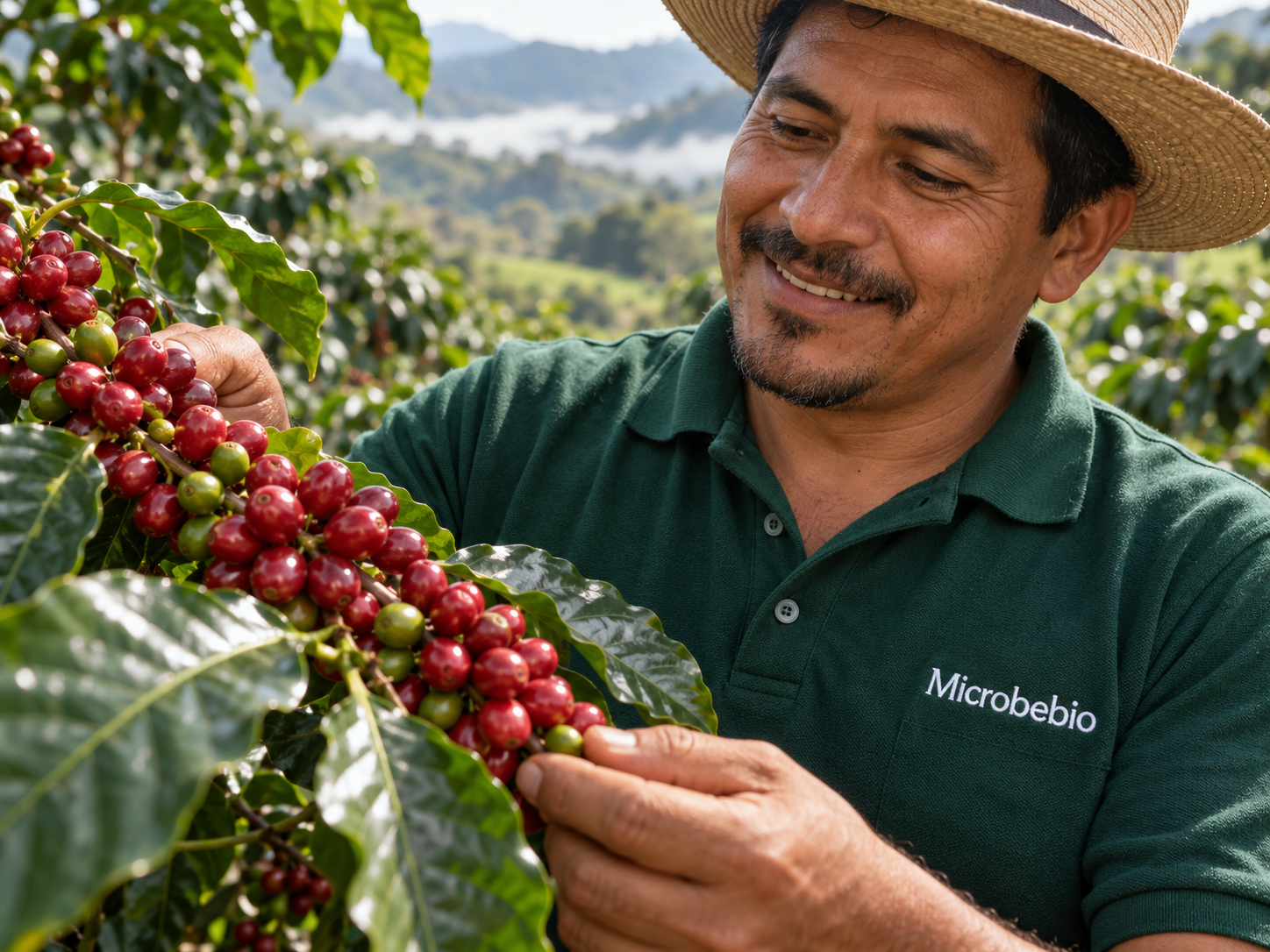
MicrobeBio and Coffee Crop Health
Biological mechanisms for managing pest and disease pressure and supporting growth and yield
A productive coffee farm begins with healthy roots, a functioning soil ecosystem and a canopy capable of carrying a crop through harvest. When fungal diseases damage leaves, insects attack berries or nematodes injure roots, the consequences reach beyond visible symptoms. Plants lose the ability to capture sunlight, absorb nutrients and develop a marketable crop.
MicrobeBio’s biological approach connects crop protection with root health and nutrition. Beneficial bacteria, fungi and mycorrhizae can contribute complementary functions: competing with pathogens, producing inhibitory compounds, infecting susceptible insects, supporting plant defenses and helping roots access nutrients. The goal is to preserve the plant’s productive capacity throughout the season.
This article covers every disease group in the supplied coffee infographic, additional important coffee diseases and major insect and nematode pests. Product descriptions follow the MicrobeBio formulations supplied for this draft. The product-to-problem mappings are proposed biological fits, not verified MicrobeBio efficacy claims or confirmation of registration. Use only applications permitted by the current local product label. Scientific results for a particular strain or another commercial product do not establish equivalent performance for a MicrobeBio blend.
Coffee diseases and where biological management can contribute
1. Coffee leaf rust
Coffee leaf rust, caused by Hemileia vastatrix, produces orange-yellow powdery pustules, particularly on leaf undersides. Increasing infection can cause defoliation, weaken branches and reduce the leaf area supporting current and future crops.
Potential MicrobeBio fit: X5 as a candidate component of a preventive foliar program, where its label permits coffee and the application route. Aqua Activator, Nature Vigor and MycoX serve a separate role in supporting nutrition and root function.
Mechanism and mode of action: Suitable Bacillus strains can produce antifungal lipopeptides that interfere with fungal membranes or spore development. Some beneficial bacteria also prime plant defenses. Coffee field research has investigated specific Bacillus and Pseudomonas isolates against rust, providing a rationale for evaluating biological antagonists; it does not prove that X5 controls rust. [1]
Practical integration: Monitor infection, grow suitable resistant varieties, maintain balanced nutrition and manage canopy conditions. Biological prevention should be evaluated before heavy infection. A root treatment cannot be assumed to provide direct control of an established leaf infection.
2. Coffee berry disease
Coffee berry disease, associated with Colletotrichum kahawae, causes dark, sunken lesions on green berries, followed by shriveling or premature drop. Diagnosis matters because other Colletotrichum species can cause superficially similar lesions.
Potential MicrobeBio fit: X5 is a candidate for evaluation in a preventive berry-protection program; X1 and growth-support products address the root environment.
Mechanism and mode of action: Selected Bacillus and related bacteria can inhibit fungal growth through antimicrobial metabolites and competition. Suitable Trichoderma strains can antagonize fungi through enzymes, metabolites and direct parasitism, although success on exposed berries requires a formulation and strain adapted to that environment.
Practical integration: Use clean planting material, locally recommended resistant cultivars, sanitation and disease-directed protection during susceptible stages. Species-level laboratory activity against Colletotrichum is insufficient to claim field control of coffee berry disease by a finished product. [2, 3]
3. Cercospora brown eye spot and berry blotch
Cercospora coffeicola causes circular leaf lesions with pale or gray centers and darker margins, often surrounded by yellowing. Berry infections can damage fruit. Nutrient imbalance and plant stress can increase vulnerability.
Potential MicrobeBio fit: X5 for evaluation against the pathogen, combined with Aqua Activator or Aqua Activator Plus, Nature Vigor and MycoX for a soil-test-guided root and nutrition program.
Mechanism and mode of action: Antagonistic microbes may limit fungal establishment. Nutrient-mobilizing bacteria and mycorrhizae can support access to existing soil nutrients, while healthier roots support canopy function. Correcting nutrient stress complements disease management; it does not itself eradicate Cercospora.
Practical integration: Confirm the diagnosis, correct nutrient deficiencies and water stress, and protect nursery plants and developing berries using locally validated practices. [2]
4. Thread blight and black rot
Thread blight, also called koleroga and associated with the Corticium/Ceratobasidium koleroga complex, can produce fungal strands linking leaves and twigs. Leaves and berries may blacken, and dead leaves can remain suspended by fungal threads.
Potential MicrobeBio fit: X5 is a candidate for disease-specific trials. Root-support products may help remaining healthy tissue sustain growth.
Mechanism and mode of action: Microbial antagonism may reduce pathogen growth when the antagonist reaches and persists at the infection site. Trichoderma enzymes can attack fungal cell-wall components, and suitable bacterial metabolites can inhibit fungal development. These mechanisms require coffee-specific validation for this disease.
Practical integration: Improve air circulation, manage excessive canopy humidity and remove infected material appropriately. Dense, wet canopies can overwhelm a preventive treatment. No verified MicrobeBio control data for thread blight were supplied.
5. Anthracnose and twig dieback
Colletotrichum species can damage coffee leaves, berries and twigs, producing necrotic lesions and dieback. Similar symptoms can also result from other pathogens, overbearing or environmental stress.
Potential MicrobeBio fit: X5 for evaluating preventive protection; X1, Aqua Activator and MycoX for root and establishment support.
Mechanism and mode of action: Competition, antimicrobial metabolites and defense priming may help reduce the opportunity for infection. Biological management is most useful when it protects healthy tissue and reduces new damage rather than being presented as a way to restore dead branches.
Practical integration: Diagnose the cause, remove badly affected tissue, sanitize tools and correct underlying stress. Maintain the distinct diagnosis of coffee berry disease rather than treating all anthracnose symptoms as the same problem.
6. Coffee root diseases
The supplied image groups brown root disease, red root disease, black root disease and Fusarium-associated root problems. It associates these with Rosellinia, Corticium, Ilyonectria and Fusarium, respectively. Color and appearance alone do not reliably identify the pathogen, and some names in coffee disease references are historical. Confirm the causal organism before selecting treatment.
Potential MicrobeBio fit: X1 for the root zone and X5 where soil application is permitted. MycoX and growth-support products may support healthy roots during establishment or recovery.
Mechanism and mode of action: Root-colonizing Bacillus, Pseudomonas, Paenibacillus and Streptomyces can compete for nutrients and colonization sites and, depending on strain, produce inhibitory compounds. Trichoderma can colonize root-adjacent habitats, compete with pathogens and parasitize susceptible fungi. Mycorrhizae extend the nutrient-absorbing network of compatible living roots; they do not regenerate roots already destroyed by disease.
Practical integration: Improve drainage, use clean nursery stock and address infected woody residues where relevant. Advanced root rot may require removal of affected plants and specialist advice. A microbial drench cannot compensate for persistent waterlogging or extensive structural root damage.
Additional coffee diseases to include in farm monitoring
Coffee faces more problems than one infographic can capture. Depending on location, monitor for nursery damping-off, collar rot, coffee wilt, pink disease, American leaf spot, other leaf blights and bacterial blight. Coffee ringspot is a viral disease and requires a different management approach. The APS coffee disease list documents this broader diagnostic landscape. [2]
X1 and X5 may be candidates for research against selected nursery and soilborne fungal pathogens. Coffee wilt associated with Fusarium xylarioides demands particular attention to sanitation, clean planting material and local disease-management guidance. General activity against another Fusarium species does not demonstrate control of coffee wilt. Bacterial blight likewise needs pathogen-specific evidence; an antifungal mechanism is not proof of antibacterial performance. MicrobeBio products should not be represented as curing plant viruses.
Major coffee pests and the biological opportunity
Coffee berry borer — Hypothenemus hampei
Berry borer females enter coffee berries, where developing insects damage beans and reduce marketable quality. This is the strongest coffee-specific biological opportunity for the Beauveria component of X3.
Mechanism and mode of action: Beauveria bassiana spores attach to a susceptible insect, germinate, penetrate the cuticle and grow inside the body. Contact is critical. Coffee research supports integrating Beauveria with monitoring and harvest sanitation, especially when borers remain exposed rather than deeply protected within berries. [4]
MicrobeBio fit: Evaluate X3 as part of a locally authorized integrated program. Evidence for another Beauveria strain or formulation cannot be transferred automatically to X3. Remove residual berries, monitor pest activity and time treatments around accessible insects.
Coffee leaf miners — Leucoptera species
Larvae mine inside leaves, reducing functioning leaf tissue. X3 may be a candidate for testing against susceptible, accessible stages, but larvae protected within mines can be difficult to reach.
Mechanism and mode of action: Appropriate Bacillus thuringiensis strains act when susceptible larvae ingest active proteins. Those proteins bind to receptors in the larval gut and disrupt gut function. Bt activity is highly strain- and toxin-specific; the presence of the species in a blend does not establish activity against coffee leaf miner. Fungal components also require effective contact with a susceptible stage. [5]
White stem borers, twig borers and other wood-boring insects
Depending on region, coffee may be affected by white stem borers such as Xylotrechus quadripes and black twig borer, Xylosandrus compactus. Galleries damage branches or stems and protect insects from surface treatments.
MicrobeBio fit and mechanism: Beauveria or Metarhizium in X3 provide a biological rationale for evaluating exposed adult stages. Do not claim that a surface spray reliably reaches or eliminates insects inside wood. Combine monitoring with removal of infested material and locally recommended measures.
Mealybugs, scale insects, aphids, thrips and whiteflies
These pests can weaken plants through feeding. Some honeydew-producing species encourage sooty mold, while ant activity can complicate management.
MicrobeBio fit and mechanism: X3 contains entomopathogenic fungi, including Beauveria, Metarhizium, Lecanicillium and Cordyceps/Isaria, that provide candidate mechanisms against susceptible exposed insects. Their spores must contact the insect and experience suitable conditions for infection. Pest species, life stage, humidity, coverage and strain identity determine results. Ant management and protection of useful natural enemies remain important.
Antestia bugs and other berry-feeding bugs
These insects injure berries and can impair crop quality. X3 is a candidate for pest-specific trials, rather than an established answer for every bug species. Contact infection by suitable fungi and activity from certain bacterial metabolites offer possible routes for suppression, but finished-product efficacy must be measured.
Mites
Some microbial strains and metabolites have activity against certain mites, but a broad claim that X3 controls coffee mites is not supported by the information supplied. Diagnose the mite, conserve relevant natural enemies and use validated local controls. Chromobacterium subtsugae evidence relates to particular strains and preparations; live-cell counts alone do not establish equivalent insecticidal or acaricidal potency. [6]
Plant-parasitic nematodes
Root-knot nematodes, Meloidogyne species, and root-lesion nematodes, Pratylenchus species, can damage roots and undermine nutrient uptake. Healthy-looking shoots may conceal substantial belowground injury.
MicrobeBio fit: X1 is a candidate for a root-health program. X1 Ultra, if its current formulation includes Pochonia, Purpureocillium and Bacillus firmus, provides additional nematode-focused mechanisms to evaluate.
Mechanism and mode of action: Certain Pochonia and Purpureocillium strains parasitize nematode eggs, using enzymes to penetrate protective layers. Suitable bacteria can affect susceptible nematode stages through metabolites and root interactions. Coffee field research has evaluated Trichoderma asperellum and Purpureocillium lilacinum against root-knot nematodes; it supports biological evaluation, not a claim of equivalent efficacy for X1 or its different Trichoderma species. [7]
Use laboratory soil and root testing to identify the nematode and measure population changes. Combine biological approaches with clean nursery plants, suitable resistant material and other locally validated practices.
Where X8 belongs
X8 and X8 Plus were developed in the supplied product information for golden apple snail applications. Snails are not a principal coffee target, and insect-pathogenic fungi are not automatically proven molluscicides. X8 should not be added to a coffee program or advertised as controlling coffee pests based only on its ingredient list.

How the MicrobeBio portfolio connects protection with growth
X1 — Support the living root zone
The supplied core formula combines Bacillus subtilis, B. amyloliquefaciens, B. licheniformis, Paenibacillus polymyxa, Pseudomonas fluorescens, Streptomyces and Trichoderma. Its proposed role is to help establish beneficial root-zone biology and evaluate suppression of selected soilborne pressures. Root colonization, competition, microbial metabolites and fungal antagonism provide complementary mechanisms. The actual effects depend on strains, viability and successful establishment.
X5 — Evaluate biological disease management
X5 combines B. subtilis, B. velezensis, B. amyloliquefaciens, Paenibacillus polymyxa, Trichoderma harzianum, Streptomyces and Pseudomonas fluorescens. Suitable strains may contribute membrane-active lipopeptides, other antimicrobial compounds, competition and defense priming. These effects are strain-dependent, and not every member of a species produces every listed compound. A multi-organism formula should demonstrate compatibility and efficacy rather than assume that more organisms guarantee better control. [3]
X3 — Evaluate biological insect management
X3 combines Beauveria bassiana, Metarhizium anisopliae, Bacillus thuringiensis, Chromobacterium subtsugae, Lecanicillium lecanii and Cordyceps/Isaria fumosorosea. Fungal infection provides a contact pathway, while an appropriate Bt component provides an ingestion pathway for susceptible larvae. Certain Chromobacterium preparations add metabolite-mediated feeding or toxicity effects. These mechanisms can complement one another, but each pest and formulation requires validation.
Aqua Activator and Aqua Activator Plus — Support nutrient access and root development
The formulations supplied include different bacterial and fungal combinations, so select the actual local formulation. Suitable nutrient-mobilizing bacteria can release some phosphorus or potassium from less available pools through organic acids and other processes. Selected diazotrophs can fix atmospheric nitrogen under appropriate conditions, although their contribution must be measured and should not be treated as a guaranteed replacement for fertilizer. Root-associated organisms may influence branching and nutrient uptake.
Nature Vigor — Combine humate, seaweed and microbial functions
The supplied Nature Vigor formulation includes potassium humate, seaweed and selected microorganisms. Its proposed contribution is support for nutrient management and root growth, with microbial decomposition and nutrient cycling where the relevant organisms establish. Humate and seaweed responses depend on composition, concentration, soil and crop conditions. Nature Vigor supplies no basis for promising a fixed yield increase or direct control of every disease.
MycoX — Extend the root absorption network
MycoX supplies arbuscular mycorrhizal fungi separately from the other blends. Compatible roots exchange plant carbon for nutrients acquired through fungal hyphae extending beyond the root surface. This can improve access to relatively immobile nutrients, particularly phosphorus, and sometimes support water relations under stress. Success requires viable propagules and contact with living roots. Soil phosphorus, existing mycorrhizae and management affect the response. Published crop meta-analyses show variable benefits; they do not establish a coffee yield percentage for MycoX. [8]
Rhizo Activator — Match the program to the actual formulation
The supplied Rhizo Activator descriptions include different formulations. The latest WP direction uses Bacillus, Trichoderma and mixed mycorrhizae, without Azotobacter. Evaluate it for nursery establishment and root support using its current composition and label. Do not transfer nutrient specifications, counts or application rates from the granular formulation to the WP.
The pathway to better growth and marketable yield
Biological inputs can support productivity through several connected pathways. Reduced root damage can preserve nutrient and water uptake. Reduced canopy injury can preserve photosynthesis. Lower berry damage can protect the marketable portion of the harvest. Improved root exploration and nutrient mobilization can support establishment and vegetative growth when those functions are limiting.
Together, these effects can help a coffee crop retain the capacity to flower, fill berries and recover after harvest. The relevant outcome is marketable green coffee and net return, not simply greener leaves. Record yield, bean defects, size distribution and quality measures alongside pest and disease assessments. Avoid promising universal yield increases, higher cup scores or elimination of pesticide use without supporting farm data.
A practical biological coffee program
Begin with diagnosis. Map affected areas, identify causal organisms and test soil, roots and plant nutrition. Separate infectious disease from drought, waterlogging, deficiencies and overbearing.
Build the root foundation. Use clean planting material, appropriate drainage and soil-test-guided nutrition. Select X1, Aqua Activator, Nature Vigor, MycoX or the correct Rhizo formulation according to the specific need and authorized use, rather than automatically applying every product.
Protect susceptible tissue at the right time. Evaluate X5 preventively against a defined disease. Match any permitted foliar application to the infection site and crop stage.
Target accessible pests. For X3 evaluation, monitoring should guide timing. Berry-borer sanitation and exposed-stage targeting are particularly important. Microbial insecticides generally need time to act and cannot be assumed to provide immediate knockdown.
Protect product viability. Follow storage and water-quality instructions, maintain suitable agitation and check compatibility before combining living organisms with other inputs. A jar test checks physical compatibility; it does not prove that microbes remain alive. Fungicides, disinfectants and strongly unsuitable water conditions can interfere with biological performance.
Measure performance. Compare replicated treated and standard-practice blocks with similar variety, age and management. Assess disease incidence and severity, pest infestation, nematode populations where relevant, root condition, marketable yield and treatment cost. Set crop-specific rates and intervals from the authorized label and local trials; generic hectare rates are not automatically suitable for mature coffee trees.
MicrobeBio and the future of healthier coffee
Coffee farmers need crop protection that fits the biology of their farms. MicrobeBio offers a portfolio that can be evaluated across the connected needs of roots, nutrition, disease pressure and insect management. Its opportunity is to turn well-established microbial mechanisms into dependable, locally demonstrated performance.
Healthy roots help sustain the canopy. A functioning canopy supports developing berries. Protecting berries preserves the value of the harvest. With correct diagnosis, quality biological inputs and a practical integrated program, growers can work toward healthier coffee and more resilient production.
Contact MicrobeBio to discuss a locally appropriate coffee program, confirm the relevant product specifications and authorized uses, and design a field evaluation that measures crop health, marketable yield and economic return.
Scientific references and evidence notes
[1] Biological control of coffee rust by antagonistic bacteria under field conditions in Brazil. Biological Control. Specific experimental isolates; not a MicrobeBio product trial.
https://www.sciencedirect.com/science/article/pii/S1049964409000474
[2] American Phytopathological Society. Diseases of Coffee. Disease names and causal agents; not evidence of product efficacy. Historical names may require current diagnostic interpretation.
https://www.apsnet.org/edcenter/resources/commonnames/Pages/Coffee.aspx
[3] Ongena and Jacques. Bacillus lipopeptides: versatile weapons for plant disease biocontrol. Trends in Microbiology. General biological mechanisms; not a coffee trial of MicrobeBio products.
https://www.sciencedirect.com/science/article/pii/S0966842X08000383
[4] Hollingsworth et al. 2020. Incorporating Beauveria bassiana Into an Integrated Pest Management Plan for Coffee Berry Borer in Hawaii. Coffee-specific research with its own strains and treatments.
https://www.frontiersin.org/journals/sustainable-food-systems/articles/10.3389/fsufs.2020.00022/full
[5] US EPA. What are Biopesticides? Explains strain-specific microbial pest activity and Bt host specificity. This does not confirm registration of a MicrobeBio product.
https://www.epa.gov/ingredients-used-pesticide-products/what-are-biopesticides
[6] US EPA. Biopesticides Registration Action Document for Chromobacterium subtsugae strain PRAA4-1T. Evidence is specific to the reviewed strain and preparation.
https://www3.epa.gov/pesticides/chem_search/reg_actions/registration/decision_PC-016329_27-Sep-11.pdf
[7] Biocontrol-based strategies for improving soil health and managing plant-parasitic nematodes in coffee production. Frontiers in Plant Science, 2023. Evaluates Trichoderma asperellum and Purpureocillium lilacinum on established coffee in Kenya.
https://www.frontiersin.org/journals/plant-science/articles/10.3389/fpls.2023.1196171/full
[8] Zhang et al. 2019. Arbuscular mycorrhizal fungi increase grain yields: a meta-analysis. Broad crop evidence of variable responses; not coffee-specific proof or a MycoX trial.
https://doi.org/10.1111/nph.15570
Publication note: This draft is based on supplied product formulations and publicly available science. Before publishing pesticide claims, reconcile each named target, crop, application route and benefit with the current label, local authorization and supporting finished-product data. No MicrobeBio coffee efficacy trials or current registered labels were supplied.