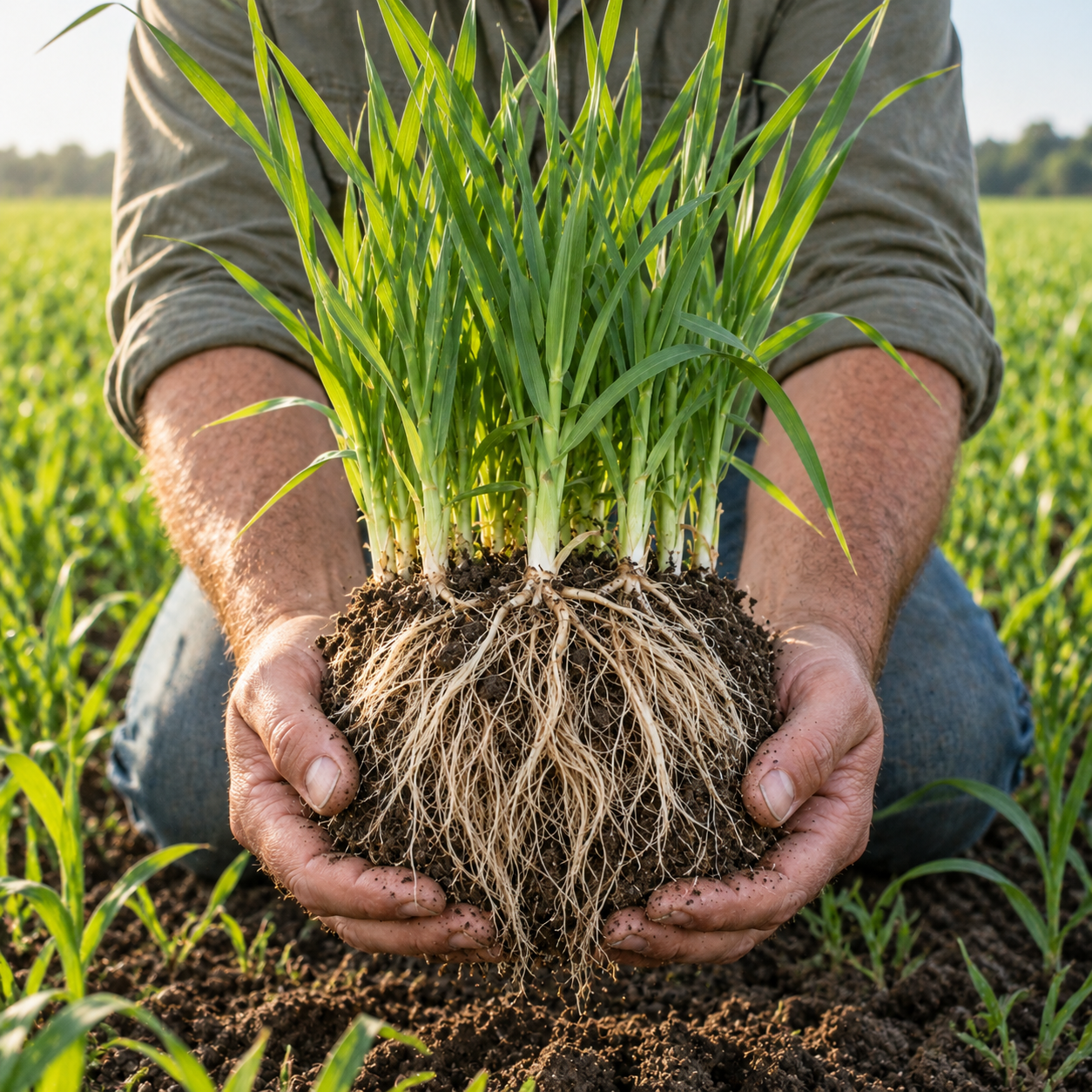
The Rhizosphere Where MicrobeBio® Technology Works
The Rhizosphere
Where MicrobeBio® Technology Works
The biologically active zone around plant roots is where soil, microorganisms, water, minerals, nutrients, and plant-derived carbon meet. Understanding this interface is central to building biologically informed crop programs.
Healthy Soil. Active Rhizosphere. Stronger Roots. Better Crops.
The root soil interface drives biological activity
The rhizosphere is the narrow zone of soil directly influenced by living roots. It is not simply soil located near a plant. It is a dynamic habitat shaped by root growth, root exudates, microbial metabolism, soil minerals, organic matter, oxygen, and water. Because these factors interact at very small spatial scales, the rhizosphere can differ substantially from bulk soil only millimeters away.
Plants release sugars, amino acids, organic acids, mucilage, and other compounds through their roots. These materials provide energy and chemical signals that help select and sustain microbial communities. Microorganisms, in turn, may transform nutrients, produce metabolites, alter local chemistry, compete for resources, influence soil aggregation, and interact directly with root surfaces. The result is a continuously changing biological exchange rather than a one-way input process.
MicrobeBio® technologies are designed to support beneficial microbial activity within this critical zone. Their agronomic value should be understood as part of a complete system that includes crop genetics, soil properties, climate, irrigation, fertility, organic matter, application method, product quality, and management timing. Biological products do not replace sound agronomy; they are intended to complement it.
Main conclusion
A biologically active rhizosphere can contribute to nutrient cycling, mineral availability, root development, soil structure, water relationships, biological competition, and crop resilience. Actual outcomes remain site-specific and should be verified through appropriate field evaluation.
Rhizosphere fundamentals
A living zone created by roots
The term rhizosphere describes soil whose physical, chemical, and biological properties are influenced by roots. Scientists often distinguish the soil attached to roots, the root surface, and internal root tissues because each supports a different microbial community. Together, these closely connected habitats form a gradient from bulk soil toward the plant.
Carbon begins the exchange
Photosynthesis fixes atmospheric carbon into plant compounds. A portion of that carbon moves belowground and enters the rhizosphere through exudation, sloughed cells, mucilage, and root turnover. This carbon flow helps explain why microbial abundance and activity are frequently greater near roots than in soil farther away. Exudate composition changes with plant species, growth stage, nutritional status, stress, and soil conditions, so the rhizosphere is never biologically static.
Microorganisms transform the local environment
Bacteria, fungi, archaea, protozoa, nematodes, and other organisms form interacting food webs around roots. Some organisms mineralize organic materials; some solubilize or mobilize nutrients; some form symbioses; some compete with potential pathogens; and others consume microorganisms, releasing nutrients in plant-available forms. These functions overlap and depend on environmental conditions.
The system is selective
A root does not support every microorganism equally. Root chemistry, immune responses, soil pH, oxygen, moisture, texture, temperature, and prior management filter which organisms establish and remain active. For this reason, the presence of a microbial organism in a product or soil test does not by itself prove colonization, persistence, or agronomic effect.
How rhizosphere activity can support crops
| Rhizosphere contribution | Agronomic relevance |
| Nutrient cycling | Microbial decomposition and biochemical transformation can release or convert nutrients, influencing when and where they become available to roots. |
| Mineral availability | Organic acids, enzymes, chelating compounds, and shifts in local pH can affect the solubility and mobility of phosphorus, iron, zinc, and other elements. |
| Root development | Some beneficial microorganisms produce or modulate signaling compounds associated with root branching, root hairs, and root system architecture. |
| Soil structure | Fungal hyphae, microbial residues, extracellular polymers, roots, and organic matter can help bind particles into aggregates that influence pore space and aeration. |
| Water relationships | Improved aggregation, root exploration, and microbial polymers may influence infiltration, water retention, and plant access to soil moisture; effects depend strongly on soil and climate. |
| Biological competition | Beneficial populations may compete with other organisms for nutrients and colonization sites or produce inhibitory compounds. This is ecological competition, not a guarantee of pest or disease control. |
| Crop resilience | A diverse and functional root-zone community may help plants respond to variable conditions, but resilience is an emergent system property rather than a single-organism trait. |
These pathways are interconnected. For example, stronger root growth can expand the volume of soil explored, while additional root-derived carbon can support further microbial activity. Conversely, compaction, waterlogging, salinity, extreme pH, or inadequate fertility can restrict both root and microbial function.
Availability is controlled by biology and chemistry
Soils may contain substantial total quantities of nutrients while only a fraction is accessible to plants at a given time. Nutrient availability reflects chemical form, adsorption to minerals, organic matter turnover, diffusion, mass flow, root interception, moisture, temperature, pH, and biological activity.
Nitrogen transformations
Microorganisms participate in nitrogen fixation, ammonification, nitrification, immobilization, and denitrification. These processes can either increase plant-available nitrogen or temporarily retain or lose it. The desired outcome depends on synchronizing nitrogen release with crop demand while limiting losses.
Phosphorus and micronutrients
Phosphorus frequently reacts with calcium, iron, or aluminum compounds or becomes incorporated into organic matter. Certain microorganisms may release organic acids, phosphatases, or chelators that alter nutrient availability in the immediate root zone. Similar mechanisms can affect iron, zinc, and other micronutrients. However, mobilization does not ensure plant uptake when roots are impaired or other constraints remain.
A systems interpretation
The most useful question is not whether a microorganism has a beneficial function in isolation, but whether the organism remains viable, reaches the correct site, expresses that function under field conditions, and produces a measurable response within the crop-management system.
Physical conditions determine biological opportunity
Microbial processes require suitable habitat. Water films allow solutes and cells to move, pores supply oxygen, aggregates create protected microsites, and organic materials provide energy. When soil is compacted, saturated, extremely dry, saline, or chemically imbalanced, habitat quality declines and root growth may be restricted.
Structure and aggregation
Roots physically enmesh soil and release binding materials. Fungal hyphae and microbial extracellular polymers may also contribute to aggregate formation and stability. Stable aggregation can improve the balance between water-holding pores and air-filled pores, although the direction and magnitude of change depend on texture, organic matter, tillage, and climate.
Water utilization
A more extensive root system can explore a larger soil volume. Improved infiltration and aggregation can also change how water enters and is stored in soil. Biological activity may support these processes, but it cannot overcome insufficient irrigation, prolonged flooding, severe compaction, or other major physical limitations on its own.
Management priorities
- Maintain living roots or cover where practical.
- Protect soil structure and reduce unnecessary compaction.
- Use irrigation that supports roots without creating prolonged anaerobic conditions.
- Return appropriate organic residues and maintain balanced fertility.
- Place biological inputs where viable organisms can contact suitable root-zone habitat.
Competition is one part of a complex community
The rhizosphere contains mutualists, commensals, competitors, predators, decomposers, and potential pathogens. Beneficial organisms may occupy root surfaces, compete for carbon or micronutrients, produce enzymes or metabolites, or prime plant signaling pathways. These mechanisms are important in biological ecology, but their expression varies by strain, crop, environment, dose, formulation, and timing.
Careful interpretation of biological competition
“Biological competition” should not automatically be interpreted as disease suppression or pesticidal control. A control claim requires product-specific evidence and may trigger regulatory requirements depending on the jurisdiction and label language. Where evidence is limited, the scientifically responsible description is that a technology is intended to support a favorable root-zone microbial environment.
Resilience emerges from the whole system
Crop resilience reflects the combined capacity of roots, soil, microbial communities, water management, nutrition, and plant genetics to maintain function during stress and recover afterward. Microbial technologies may contribute to this capacity, but they should be evaluated within an integrated program rather than presented as a stand-alone guarantee.
Designing technology for the rhizosphere
MicrobeBio® technologies are designed around the principle that biological inputs should function where plant demand and microbial activity intersect: the root zone. The intended role is to support beneficial processes associated with nutrient transformation, root-zone activity, soil function, and plant performance.
Four design considerations
| Rhizosphere contribution | Agronomic relevance |
| Viability | Organisms must remain viable through manufacture, storage, transport, mixing, and application. |
| Compatibility | Formulation ingredients, water quality, fertilizers, crop-protection materials, temperature, and pH can affect biological performance. |
| Placement and timing | Application should maximize contact with the active root zone and coincide with suitable moisture and crop demand. |
| Verification | Identity, potency, stability, quality-control testing, and replicated field evaluation are needed to connect a product concept to reliable performance. |
From mechanism to field result
Published research can support the plausibility of a biological mechanism. It does not, by itself, prove that a specific commercial formulation produces a specific result. Product claims should therefore be supported by data generated with the final formulation, use rate, crop, application method, and relevant growing conditions.
Field implementation
Build a measurable rhizosphere program
Biological programs are strongest when they begin with a defined agronomic constraint and a measurement plan. Soil and tissue testing, root observations, irrigation records, yield components, and treatment comparisons help determine whether a program is working.
Recommended evaluation framework
- Define the constraint: nutrient inefficiency, weak rooting, low organic matter, compaction, salinity, water-management limitations, or another measurable issue.
- Record baseline conditions: soil properties, crop stage, fertility, irrigation, weather, and prior management.
- Use an untreated or grower-standard comparison and, where possible, replicate treatments.
- Apply the final commercial formulation at the labeled rate and method.
- Measure leading indicators such as root biomass, nutrient status, soil biological indicators, or infiltration alongside yield and quality.
- Evaluate consistency across locations and seasons before making broad performance claims.
Responsible expectations
Responses may be larger where the targeted biological or soil constraint is present and smaller where soil function is already strong or another limiting factor dominates. A lack of response can reflect formulation, viability, placement, timing, environmental stress, incompatible tank mixes, or the absence of the targeted constraint.
Conclusion
Healthy soil begins at the root interface
The rhizosphere is one of agriculture’s most important biological interfaces. Plant roots supply carbon and signals; microorganisms transform organic and mineral resources; soil provides structure and habitat; and water connects these components. When this system functions well, it can support nutrient cycling, mineral availability, root development, soil structure, water relationships, biological competition, and crop resilience.
MicrobeBio® technologies are designed to strengthen beneficial activity within this zone as part of an integrated agronomic program. The most credible path forward combines sound biological design, rigorous quality control, correct field use, and transparent measurement of outcomes.
Healthy Soil. Active Rhizosphere. Stronger Roots. Better Crops.
Scientific and claims statement
This paper summarizes established scientific concepts and MicrobeBio®’s technology positioning. References to potential or associated functions describe mechanisms reported in scientific literature and do not constitute a guarantee of performance by any specific MicrobeBio® product. Product performance varies with formulation, organism or strain, viability, rate, crop, soil, climate, water, fertility, application, and management. Use products only as directed by the applicable label and local requirements.
Selected references
Scientific sources
Badri, D. V., & Vivanco, J. M. (2009). Regulation and function of root exudates. Plant, Cell & Environment, 32(6), 666–681. https://doi.org/10.1111/j.1365-3040.2009.01926.x
Berendsen, R. L., Pieterse, C. M. J., & Bakker, P. A. H. M. (2012). The rhizosphere microbiome and plant health. Trends in Plant Science, 17(8), 478–486. https://doi.org/10.1016/j.tplants.2012.04.001
Bulgarelli, D., Schlaeppi, K., Spaepen, S., van Themaat, E. V. L., & Schulze-Lefert, P. (2013). Structure and functions of the bacterial microbiota of plants. Annual Review of Plant Biology, 64, 807–838. https://doi.org/10.1146/annurev-arplant-050312-120106
Jacoby, R., Peukert, M., Succurro, A., Koprivova, A., & Kopriva, S. (2017). The role of soil microorganisms in plant mineral nutrition. Frontiers in Plant Science, 8, 1617. https://doi.org/10.3389/fpls.2017.01617
Mendes, R., Garbeva, P., & Raaijmakers, J. M. (2013). The rhizosphere microbiome: significance of plant beneficial, plant pathogenic, and human pathogenic microorganisms. FEMS Microbiology Reviews, 37(5), 634–663. https://doi.org/10.1111/1574-6976.12028
Philippot, L., Raaijmakers, J. M., Lemanceau, P., & van der Putten, W. H. (2013). Going back to the roots: the microbial ecology of the rhizosphere. Nature Reviews Microbiology, 11, 789–799. https://doi.org/10.1038/nrmicro3109
Vives-Peris, V., de Ollas, C., Gómez-Cadenas, A., & Pérez-Clemente, R. M. (2020). Root exudates: from plant to rhizosphere and beyond. Plant Cell Reports, 39, 3–17. https://doi.org/10.1007/s00299-019-02447-5
Food and Agriculture Organization of the United Nations. Soil biodiversity. https://www.fao.org/soils-portal/soil-biodiversity/
USDA Natural Resources Conservation Service. Soil health. https://www.nrcs.usda.gov/conservation-basics/natural-resource-concerns/soils/soil-health
About this
This publication is provided for general educational and informational purposes. It is not a product label, product registration, pesticide recommendation, fertilizer recommendation, warranty, agronomic prescription, or substitute for advice from a qualified local agronomist, crop adviser, regulator, or other professional.
Statements concerning biological mechanisms or potential agronomic contributions are based on general scientific literature and may not have been independently validated for every MicrobeBio® product, crop, soil type, climate, use rate, or application method. No statement should be interpreted as a representation that a product will diagnose, prevent, mitigate, treat, or control a plant disease or pest unless that use is expressly authorized on the applicable registered label.
Product composition, specifications, directions, availability, and regulatory status may vary by jurisdiction and may change. Users are responsible for confirming that a product and its intended use are permitted in the location of application and for following the current label, safety information, and applicable law. References to third-party research do not imply endorsement of MicrobeBio® or its products by the authors, publishers, institutions, FAO, USDA, or any other organization.
MICROBEBIO®, and associated names and marks are trademarks or service marks of their respective owner. Third-party names and marks belong to their respective owners. No part of this publication may be reproduced, distributed, transmitted, displayed, or adapted without prior written permission, except as permitted by law.
© 2026 MicrobeBio. All rights reserved. | microbebio.com